Expert network
Human expertise in a health intelligence system
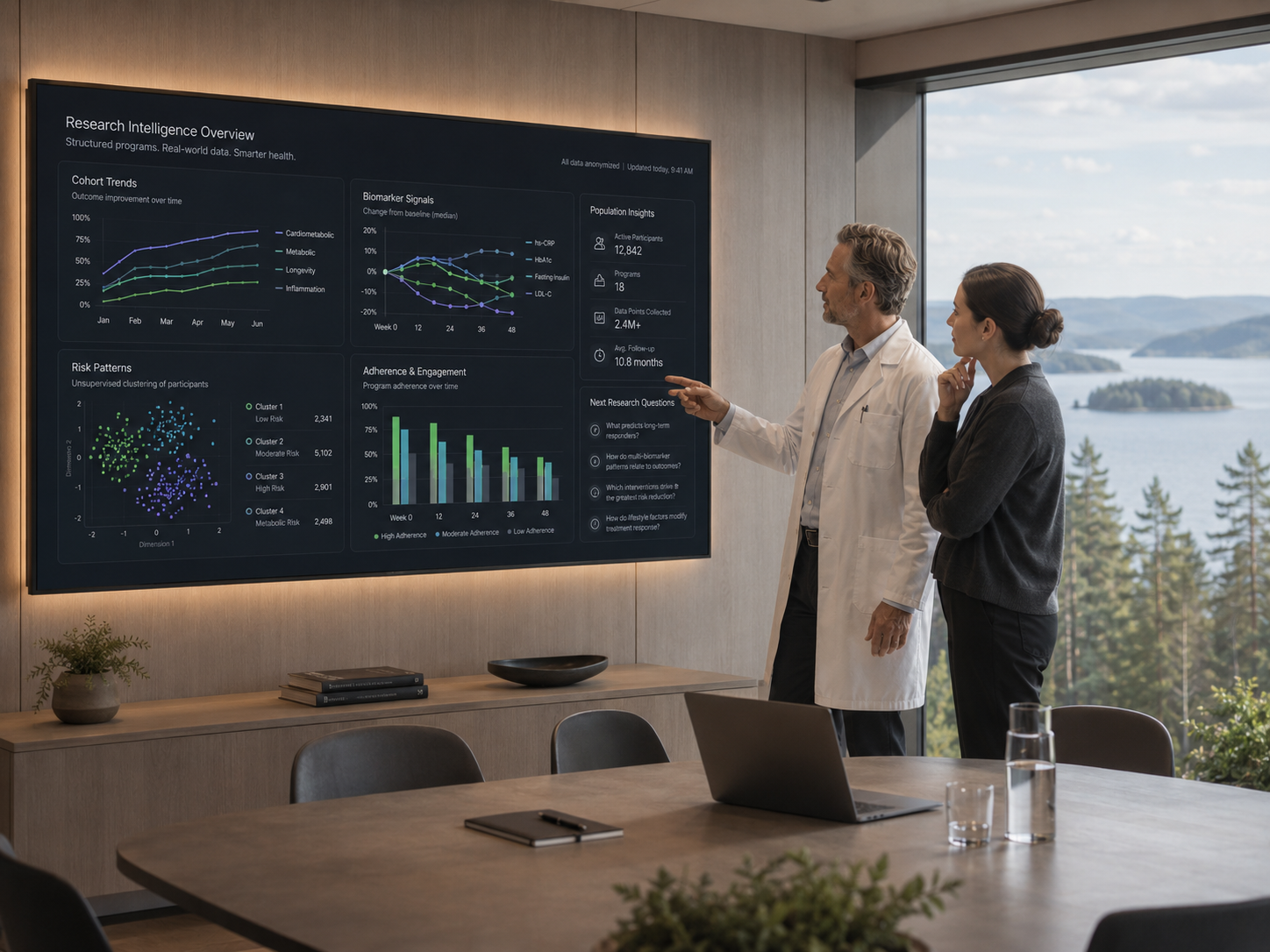
The expert network is the fourth layer of the High Coast Health Intelligence Institute model.
Human need defines the question.
Diagnostics and data make the question measurable.
The AI intelligence layer helps structure information and identify patterns.
The expert network adds judgment, responsibility and real-world experience.
Health intelligence cannot rely on data alone.
It cannot rely on AI alone.
It needs people who understand biology, medicine, diagnostics, research, technology, programs and human context.
This is why the Institute is built around a network of experts rather than a single service or single profession.
Why experts matter
Health decisions are rarely just technical.
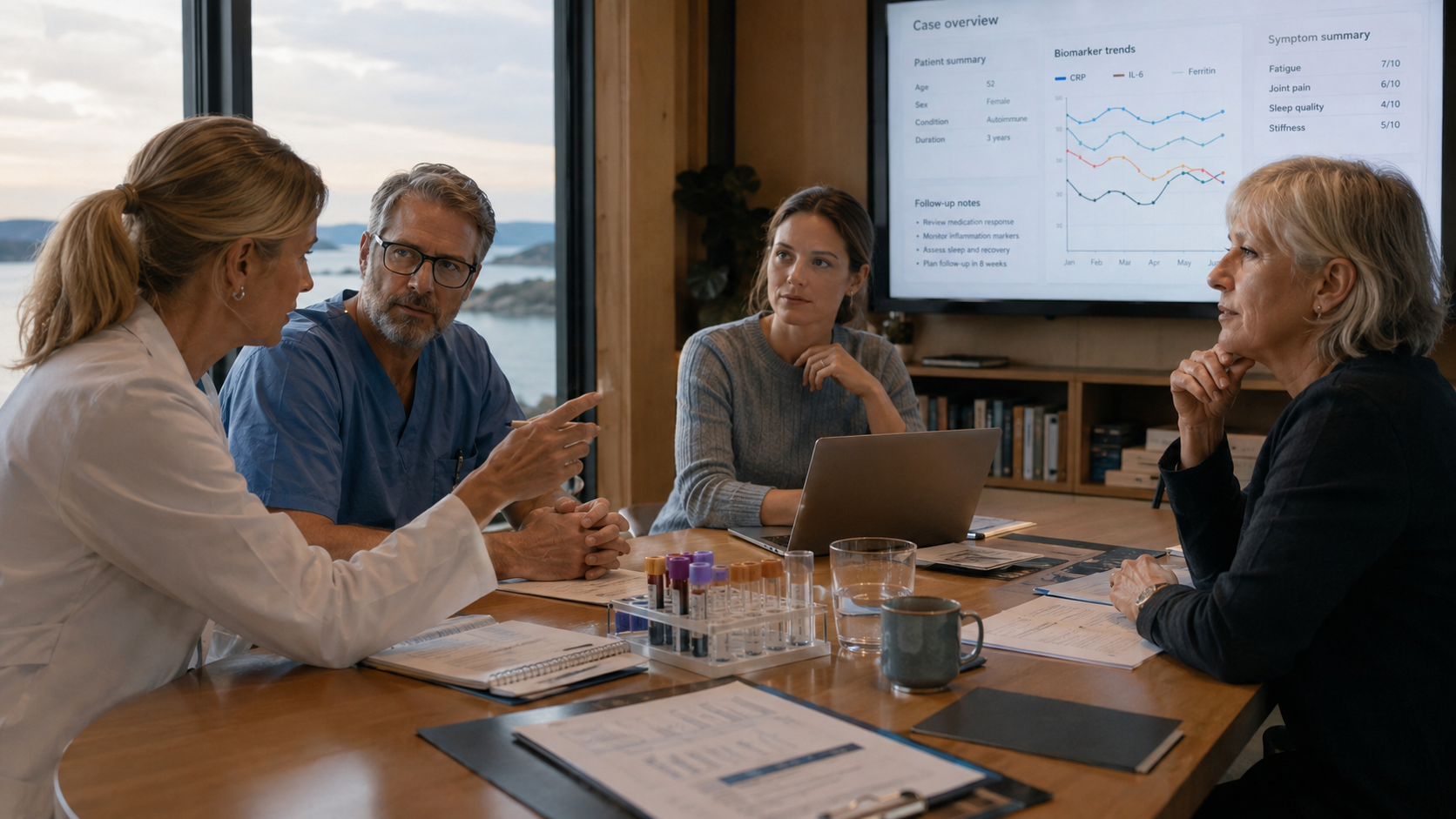
A test result may need medical interpretation.
A trend may look concerning but be explained by timing, history or context.
A symptom may need to be understood together with risk factors, previous events and clinical judgment.
An AI system may identify a pattern, but that pattern still needs to be evaluated responsibly.
Expertise matters because health is complex.
The same data can mean different things in different people.
The expert network helps make sure that information is interpreted carefully, practically and responsibly.
A network, not a silo
Traditional health systems often separate functions.
- Laboratories produce results.
- Clinicians interpret symptoms.
- Researchers study data.
- Technology companies build tools.
- Program providers deliver interventions.
- Partners develop products.
Each part may be strong, but the connections between them are often weak.
High Coast Health Intelligence Institute is designed to connect these capabilities into a shared model.
The expert network may include:
- clinicians, specialists, laboratory professionals, researchers
- data scientists, AI developers
- nutrition and lifestyle experts
- program leaders
- digital health partners
- regional and strategic partners
The purpose is to create a system where different forms of expertise can work together.
Clinical expertise
Clinical expertise is essential whenever health information may influence a person’s decisions, follow-up or care.
Clinicians help understand symptoms, risk factors, medical history, test results and possible next steps.
In some situations, the right decision may be reassurance.
In others, it may be follow-up testing, a structured program, closer monitoring or referral into regular healthcare.
The Institute model is not built to replace healthcare.
It is built to support better decisions around health questions, diagnostics, prevention, monitoring and follow-up.
Clinical expertise helps maintain this boundary.
Research expertise
Research expertise gives the Institute its learning structure.
Structured programs can generate valuable real-world data, but only if the data is handled carefully and interpreted responsibly.
Researchers help define questions, evaluate patterns, build models and separate useful signals from noise.
They also help ensure that the Institute’s work develops beyond individual services.
A program should not only answer the question of one person.
Over time, it should also help improve knowledge for future participants, clinicians, partners and society.
Research expertise makes this possible.
Laboratory and diagnostic expertise
Diagnostics are only useful when they are reliable, relevant and interpreted correctly.
Laboratory and diagnostic experts help ensure that testing is meaningful, quality-controlled and connected to the right questions.
This includes selecting relevant biomarkers, understanding limitations, building testing pathways, documenting results and supporting interpretation standards.
A biomarker should not be used simply because it is available.
It should be used because it can help answer a meaningful question.
Diagnostic expertise helps keep the model focused on what matters.
AI and data expertise
AI and data specialists help build the intelligence layer.
Their role is to structure information, develop models, support pattern recognition, build dashboards, improve workflows and make complex data easier to interpret.
But technical expertise must be connected to health expertise.
A technically impressive model is not enough.
It must be useful, safe, explainable enough to support trust and connected to real human needs.
The Institute brings AI and data expertise together with clinical, diagnostic and research perspectives.
That is what makes the intelligence layer practical.
Program and behavior expertise
Health decisions only matter if they can be acted on.
That is why the expert network also includes people who understand programs, lifestyle, recovery, behavior change, education, communication and experience design.
In Longevity Intelligence, this may include expertise in nutrition, physical activity, sleep, recovery, stress, physiology and structured health programs.
In Pregnancy Intelligence, this may include careful communication, emotional context, monitoring pathways and escalation routines.
In Research Intelligence, this may include program design that makes follow-up possible.
The goal is to move from interpretation to practical action.
Experts across projects
The expert network supports all Institute projects.
In Longevity Intelligence, experts help interpret biological risk factors, healthspan markers, lifestyle patterns and long-term optimization strategies.
In Pregnancy Intelligence, experts help interpret early pregnancy signals, symptoms, timing, risk context and trigger events.
In Research Intelligence, experts help turn real-world data into responsible learning, model development and new product opportunities.
In Diagnostics Intelligence, experts help design testing systems, interpretation frameworks and quality standards.
Each project needs different expertise.
But all projects depend on the same principle:
health intelligence requires human judgment.
AI supports experts — it does not replace them
The Institute’s model is built around collaboration between AI and experts.
AI can organize data, detect patterns, summarize trends and highlight possible priorities.
Experts can ask whether the pattern is meaningful, clinically relevant, safe, explainable and actionable.
This division is important.
AI can support better decisions, but it should not carry responsibility alone.
The expert network ensures that health intelligence remains grounded in human judgment.
Better decisions through collaboration
The strongest health decisions often come from combining several perspectives.
A laboratory result may show a biological signal.
A clinician may understand the person’s symptoms and history.
An AI system may detect a trend.
A researcher may recognize a larger pattern.
A program expert may know how to turn insight into action.
A partner may help scale the solution.
The Institute is built to bring these perspectives together.
This is what makes the model different from a single test, single app or single consultation.
The core idea
The expert network is the human intelligence layer of High Coast Health Intelligence Institute.
It connects clinicians, researchers, laboratories, AI and data specialists, program developers and partners.
Its purpose is to make health information more meaningful, more responsible and more actionable.
Health intelligence begins with human need.
It is measured through diagnostics and data.
It is structured by AI.
But it becomes trustworthy through expertise.