AI intelligence layer
Turning complexity into structure
The AI intelligence layer is the third step in the High Coast Health Intelligence Institute model.
Human need defines the question.
Diagnostics and data make the question measurable.
The AI intelligence layer helps turn that information into structure.
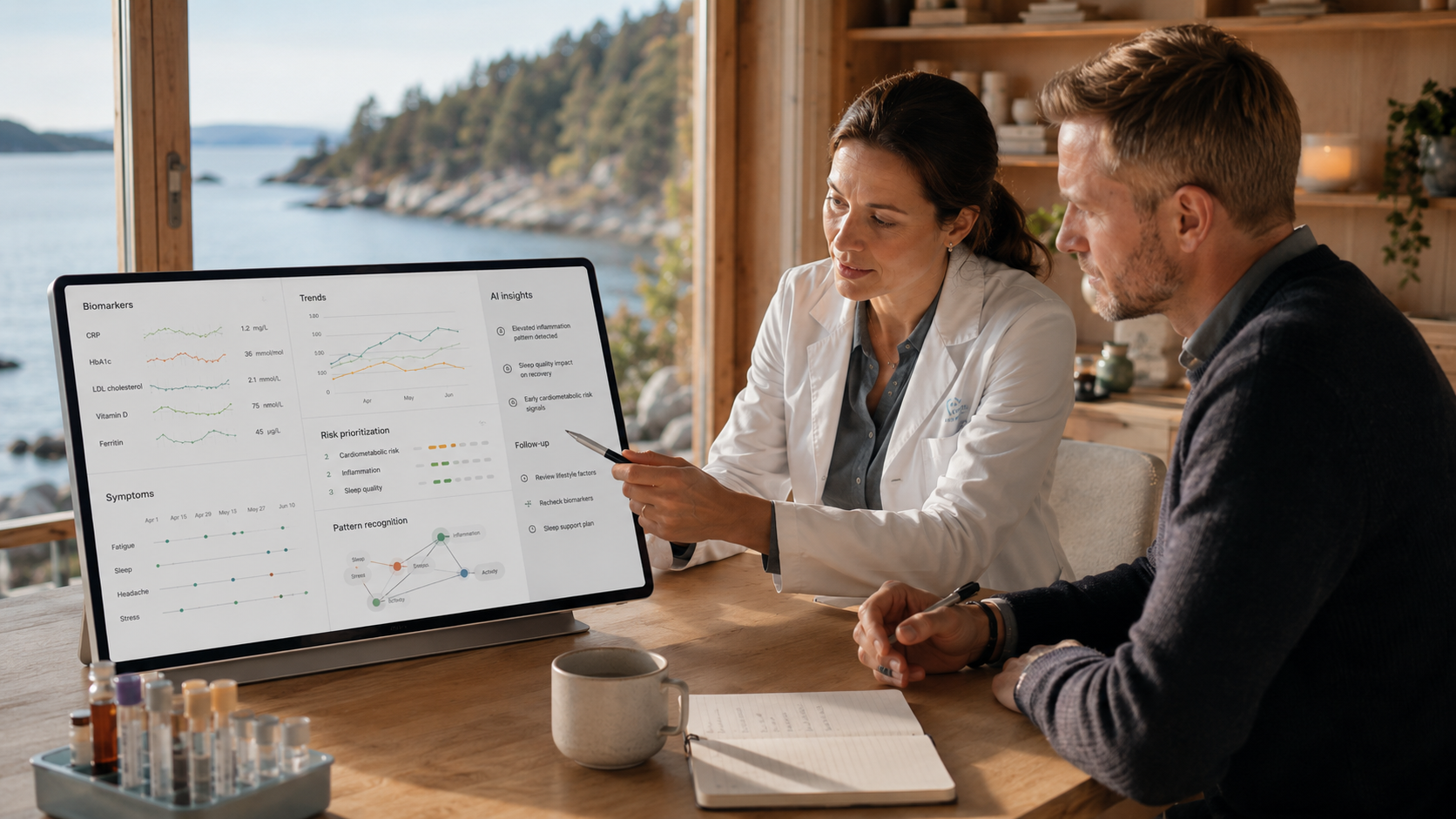
Health data can quickly become complex. A person may have blood tests, symptoms, history, wearable signals, imaging results, previous events, lifestyle information and follow-up data.
Individually, each signal may say something.
Together, they can become difficult to interpret.
The role of the AI intelligence layer is to organize this complexity, identify patterns and support better decision-making.
From data to interpretation
Data alone does not tell us what to do.
A biomarker value may be high, low or changing.
A symptom may be mild, recurring or linked to timing.
A trend may be expected, reassuring, unclear or concerning.
AI can help bring these signals together.
It can support questions such as:
What has changed over time?
Which values are stable?
Which trends may need attention?
Which symptoms match the data pattern?
Which cases may need expert review?
Which follow-up step is reasonable?
This does not mean that AI makes the final decision.
It means AI helps prepare the information so that humans can make better decisions with better context.
Pattern recognition
One of the most important roles of AI is pattern recognition.
Many health questions are not answered by a single value.
They depend on relationships.
A biomarker trend may become more meaningful when combined with symptoms.
A risk factor may matter more when connected to age, history, lifestyle or previous results.
A pregnancy signal may need to be understood in relation to timing and development.
A longevity marker may be more useful when followed over months or years.
AI can help detect patterns across these layers.
It can help identify what is changing, what is stable and what deserves closer attention.
Prioritization
Health information can overwhelm both individuals and professionals.
The AI intelligence layer can help prioritize.
It can highlight which areas may need attention first.
It can distinguish between findings that appear stable, findings that should be followed and findings that may require expert review.
This is important because health intelligence should not create unnecessary noise.
The goal is clarity.
What matters now?
What can be monitored?
What should be explained?
What should be escalated?
What should become part of a structured plan?
AI can help make this prioritization more systematic.
AI in Longevity Intelligence
In Longevity Intelligence, the AI intelligence layer can help connect biomarkers, lifestyle data, recovery signals, biological age estimates, cardiovascular markers, metabolic patterns and inflammation trends.
The goal is not to reduce longevity to a score.
The goal is to help identify which areas may be most relevant for a person’s long-term health.
For one person, the priority may be metabolic health.
For another, inflammation.
For another, recovery, sleep, cardiovascular risk or nutritional status.
AI can help organize the information and prepare a more personalized view of what should be followed and improved.
AI in Pregnancy Intelligence
In Pregnancy Intelligence, the AI intelligence layer can help structure early pregnancy monitoring.
It can connect timing, hCG trends, progesterone values, symptoms, bleeding episodes, IVF history, previous miscarriage and follow-up events.
Early pregnancy is often emotionally intense and medically sensitive.
AI should not create false certainty.
But it can help organize information, detect changes, summarize trends and support clearer next steps.
The purpose is to create more structure around monitoring and to help identify when human expertise or clinical contact may be needed.
AI in Research Intelligence
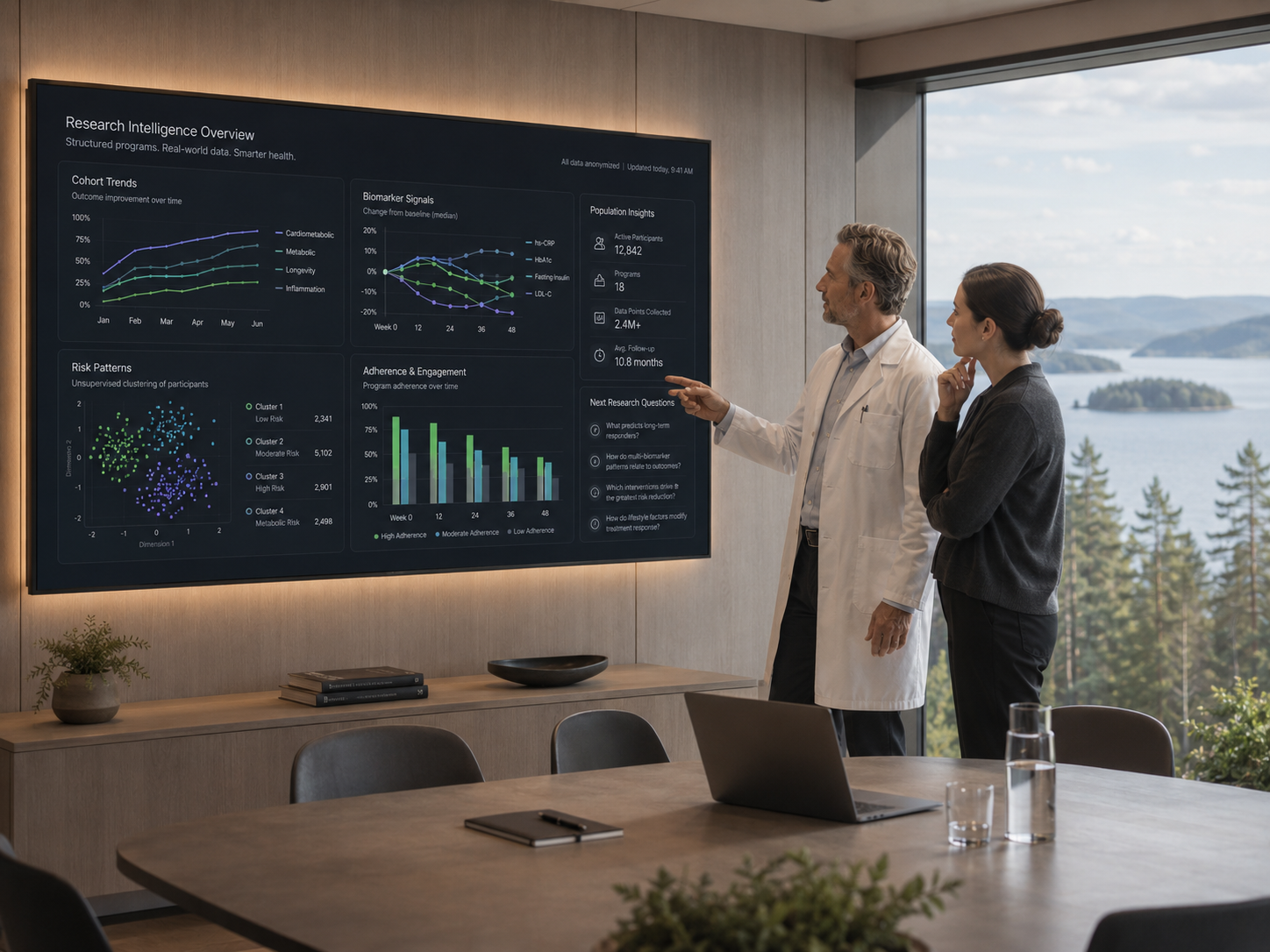
In Research Intelligence, AI can help identify patterns across responsibly collected real-world data.
It can support clustering, trend analysis, subgroup comparisons, response patterns, model development and research question generation.
This can help the Institute learn from structured programs over time.
Which signals appear important?
Which patterns are repeated?
Which interventions are associated with improvement?
Which groups respond differently?
Which questions need deeper research?
AI can help turn real-world programs into learning systems.
AI in Diagnostics Intelligence
In Diagnostics Intelligence, AI can help make testing more useful.
It can support selection of relevant markers, interpretation of combined results, longitudinal tracking and preparation of summaries for experts and participants.
A diagnostic result becomes more valuable when it is connected to context.
AI can help connect that context.
This makes diagnostics less isolated and more actionable.
Human expertise remains essential
The AI intelligence layer is not designed to replace clinicians, researchers or experts.
It is designed to support them.
Health decisions require judgment, responsibility and context.
AI can organize information, but it does not understand a human life in the way a person or professional can.
It can identify a pattern, but it cannot carry clinical responsibility alone.
It can suggest what may need attention, but expert interpretation is still needed where decisions are sensitive, complex or potentially medical.
High Coast Health Intelligence Institute uses AI as part of a broader model that includes human need, diagnostics, expert networks, structured programs, ethics and follow-up.
Responsible AI
AI in health must be used carefully.
The Institute’s approach is based on responsible use.
AI should be transparent enough to support trust.
It should be connected to human oversight.
It should be used for meaningful health questions.
It should reduce confusion rather than increase it.
It should support safety, privacy and quality.
It should help experts and participants make better decisions, not replace responsibility.
The goal is not automated medicine.
The goal is better-supported health intelligence.
From insight to action
The AI intelligence layer becomes valuable when it supports action.
A summary should help someone understand their situation.
A trend analysis should help decide what to follow.
A risk signal should help determine whether expert review is needed.
A pattern should help guide a program.
A model should help improve future decisions.
AI is useful when it helps move the person or project forward.
It should connect data to interpretation, and interpretation to action.
The core idea
The AI intelligence layer turns complex health information into structured insight.
It helps organize diagnostics, symptoms, history, trends and outcomes.
It supports pattern recognition, prioritization and decision preparation.
But it remains part of a human-centered model.
At High Coast Health Intelligence Institute, AI supports better decisions by working together with diagnostics, expert networks, structured programs and responsible learning.
The aim is not more automation.
The aim is better health intelligence.