Who we work with
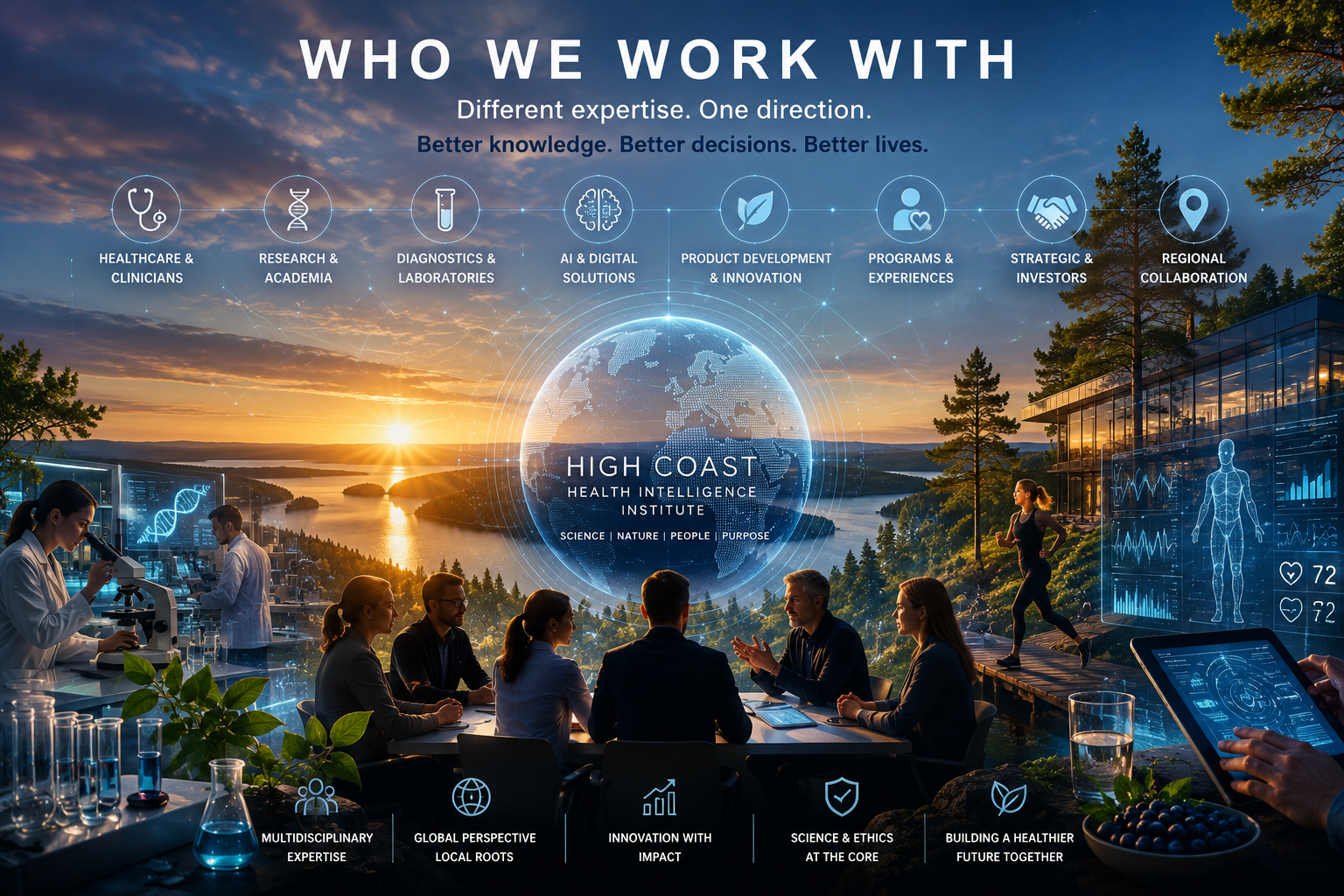
High Coast Health Intelligence Institute is built through collaboration.
The Institute brings together partners from different fields — each contributing to the development of practical health intelligence systems.
No single organization can build this alone. Health intelligence requires clinical knowledge, diagnostics, research, AI, software, program delivery, product development, regional collaboration and long-term strategy.
The Institute exists to connect these capabilities.

A multi-sector collaboration
High Coast Health Intelligence Institute works at the intersection of several domains.
This includes:
- healthcare and clinical expertise
- diagnostics and laboratory infrastructure
- research and academia
- AI, data and software development
- product development and manufacturing
- structured health programs
- experience and hospitality
- regional development
- strategic and investment partners
Each area plays a different role.
Together, they can help build systems that move health knowledge from isolated information into practical use.
Healthcare providers
Healthcare providers are important partners in developing practical health pathways.
This may include:
- clinics
- medical teams
- specialist providers
- preventive health actors
- digital care providers
- expert networks
Healthcare partners contribute clinical understanding, patient pathways, interpretation, follow-up and real-world experience.
Their role is central when diagnostics, monitoring, prevention and decision support need to become useful in practice.
Diagnostic laboratories
Diagnostics are one of the foundations of health intelligence.
The Institute works with laboratories and diagnostic partners that can contribute testing capacity, biomarker knowledge, assay development, quality systems and interpretation infrastructure.
This may include:
- clinical laboratories
- biomarker testing providers
- blood testing partners
- molecular diagnostics providers
- imaging or functional testing partners
- diagnostic platform companies
The goal is to connect testing with meaning.
A test becomes more valuable when it is connected to context, interpretation, follow-up and a structured decision pathway.
Researchers and academia
Health intelligence also creates opportunities for product development.
The Institute can collaborate with partners developing diagnostics, nutraceuticals, bioactive products, monitoring tools, educational products, digital platforms and other health-related solutions.
A product becomes more valuable when it is connected to a real need, a clear use case and a structured pathway.
The Institute can help connect products with scientific framing, program design, testing, interpretation and responsible communication.
Program Delivery
Research partners help give the Institute scientific depth.
This may include:
- universities
- research institutions
- academic groups
- independent researchers
- clinical researchers
- data science researchers
Research collaboration may focus on real-world data, study design, pattern discovery, model development, program evaluation, biomarker interpretation or new preventive health concepts.
The aim is to connect theory with practical application.
AI and software companies
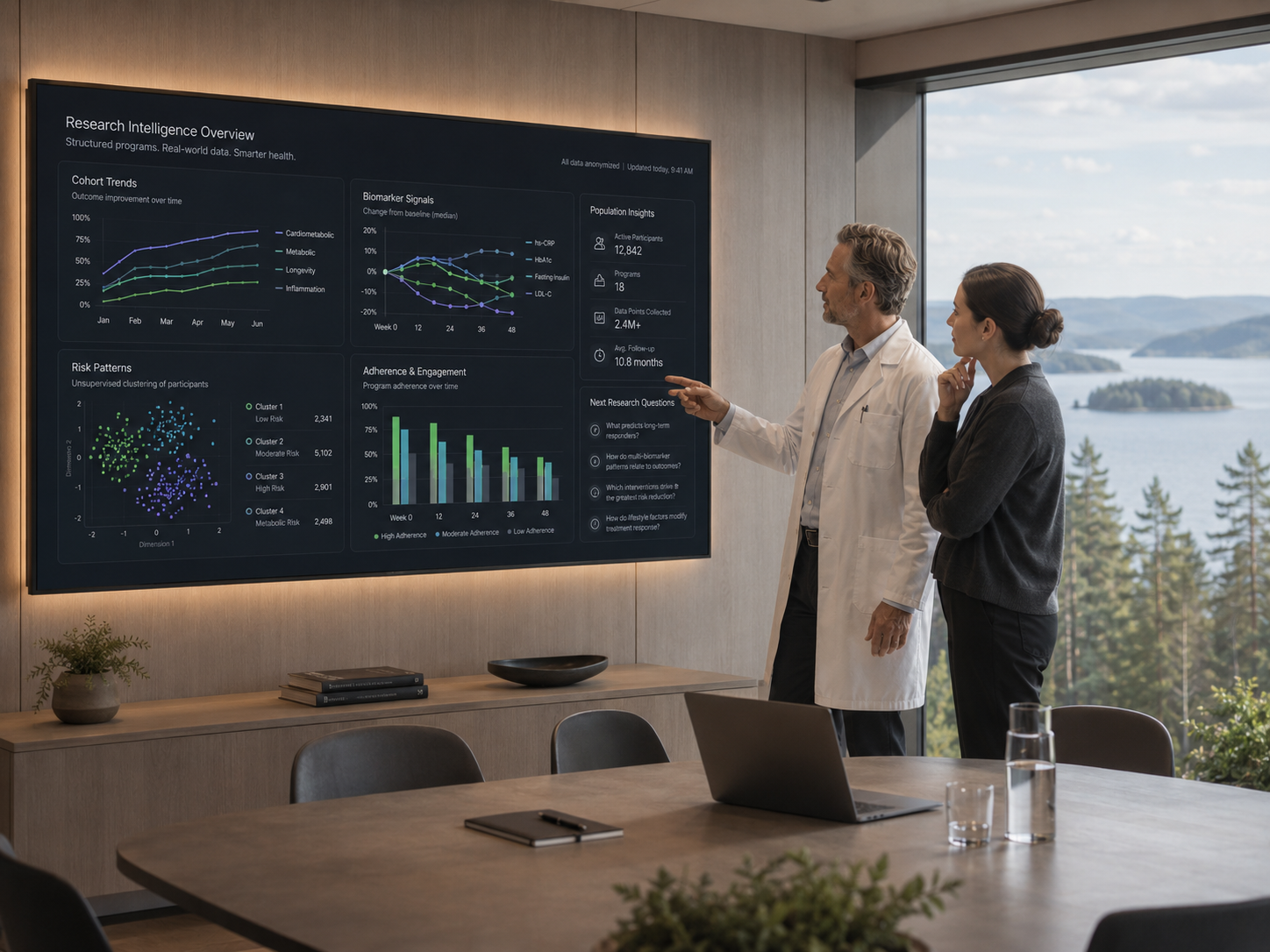
Health intelligence depends on the ability to organize complex information.
AI and software partners can help develop the digital layer of the Institute.
This may include:
- AI model development
- dashboards and data systems
- decision-support tools
- monitoring platforms
- patient interfaces
- clinical workflow tools
- secure data infrastructure
- educational and interpretation interfaces
The goal is responsible use of AI in health.
AI should not replace clinical expertise. It should help structure information, support interpretation and improve follow-up.
Product developers and manufacturers
The Institute also works with partners involved in health-related product development.
This may include:
- diagnostic products
- nutraceuticals
- supplements
- Nordic bioactive products
- monitoring tools
- laboratory equipment
- educational products
- digital health products
- prevention-focused consumer products
Product partners can contribute development capacity, production, formulation, technology, packaging, distribution and commercialization.
The Institute can help connect products to real use cases, scientific framing, structured programs and responsible communication.
Program delivery partners
Structured health programs require more than knowledge.
They need delivery.
Program partners may include:
- clinicians
- health coaches
- nurses
- digital care teams
- educators
- operational partners
- logistics partners
- program coordinators
- follow-up providers
These partners help turn knowledge into practical pathways.
This may include longevity programs, pregnancy monitoring pathways, women’s health programs, preventive health programs, metabolic health programs and future Institute projects.
Experience and hospitality partners
Some health programs benefit from a physical setting and a meaningful experience layer.
The High Coast creates opportunities for destination-based programs, retreats, recovery stays, educational meetings and partner workshops.
Hospitality and experience partners may include:
- hotels and accommodation providers
- retreat venues
- restaurants and food partners
- nature and activity providers
- tourism actors
- wellness and recovery environments
- event and meeting partners
These partners help connect health, place, rhythm, recovery and experience.
Regional stakeholders
The Institute is rooted in the High Coast.
Regional stakeholders can help connect the platform to local and regional development.
This may include:
- municipalities
- regional organizations
- local businesses
- tourism organizations
- foundations
- development agencies
- community actors
Regional partners contribute place, identity, infrastructure, local knowledge and long-term development perspective.
The aim is to build something that creates value both locally and beyond the region.
Strategic and investment partners
The Institute is a long-term platform.
Strategic and investment partners can support development, scaling and structural growth.
This may include:
- private investors
- family offices
- strategic industry partners
- development organizations
- foundations
- commercial partners
- institutional collaborators
These partners may contribute capital, networks, strategic guidance, commercialization support and long-term development capacity.
The goal is not short-term growth alone. The goal is to build a platform with durable value.
Different roles, shared direction
Partners contribute in different ways.
Some focus on clinical work.
Some focus on diagnostics.
Some focus on research.
Some focus on AI and technology.
Some focus on products.
Some focus on hospitality and experience.
Some focus on regional development.
Some focus on strategy and investment.
The roles are different, but the direction is shared: to build practical health intelligence systems that connect knowledge with better decisions.
Current phase
High Coast Health Intelligence Institute is still in an early development phase.
This means:
- partnerships are forming
- roles are being defined
- projects are being structured
- pilot models can be developed
- early partners can influence the direction
- collaboration areas can grow over time
Participation at this stage allows for co-development.
The Institute is not only looking for logos. It is looking for partners who want to help build useful systems.
What connects our partners
The common denominator is practical health intelligence.
Partners should help create something useful:
- a better diagnostic pathway
- a better interpretation model
- a better health program
- a better research structure
- a better product
- a better digital tool
- a better regional development concept
- a better decision system
The Institute is built to connect these efforts.
Summary
High Coast Health Intelligence Institute works with partners across:
- healthcare
- diagnostics
- research
- AI and software
- product development
- program delivery
- hospitality
- regional development
- strategy and investment
Together, these partners contribute to building a platform for health, science and innovation.
The goal is better knowledge, better decisions and better lives.