Diagnostics and data
Making health questions measurable
Diagnostics and data form the second layer of the High Coast Health Intelligence Institute model.
The first layer is human need.
A person has a concern, a goal, a risk factor, a symptom pattern or a need for closer follow-up.
Diagnostics and data help make that need measurable.
They turn uncertainty into signals that can be structured, interpreted and followed over time.
This does not mean measuring everything.
It means measuring what matters.
The purpose of diagnostics is not simply to produce numbers. The purpose is to support better understanding, better decisions and better follow-up.
From isolated test results to structured insight
A single test result can be useful.
But it is often only a snapshot.
Health intelligence requires more than isolated values. It requires context.
What was the question behind the test?
What does the result mean for this person?
Is the value changing over time?
Does it fit with symptoms, history or risk factors?
Does it require action, follow-up or expert review?
High Coast Health Intelligence Institute is designed to connect test results with a broader structure.
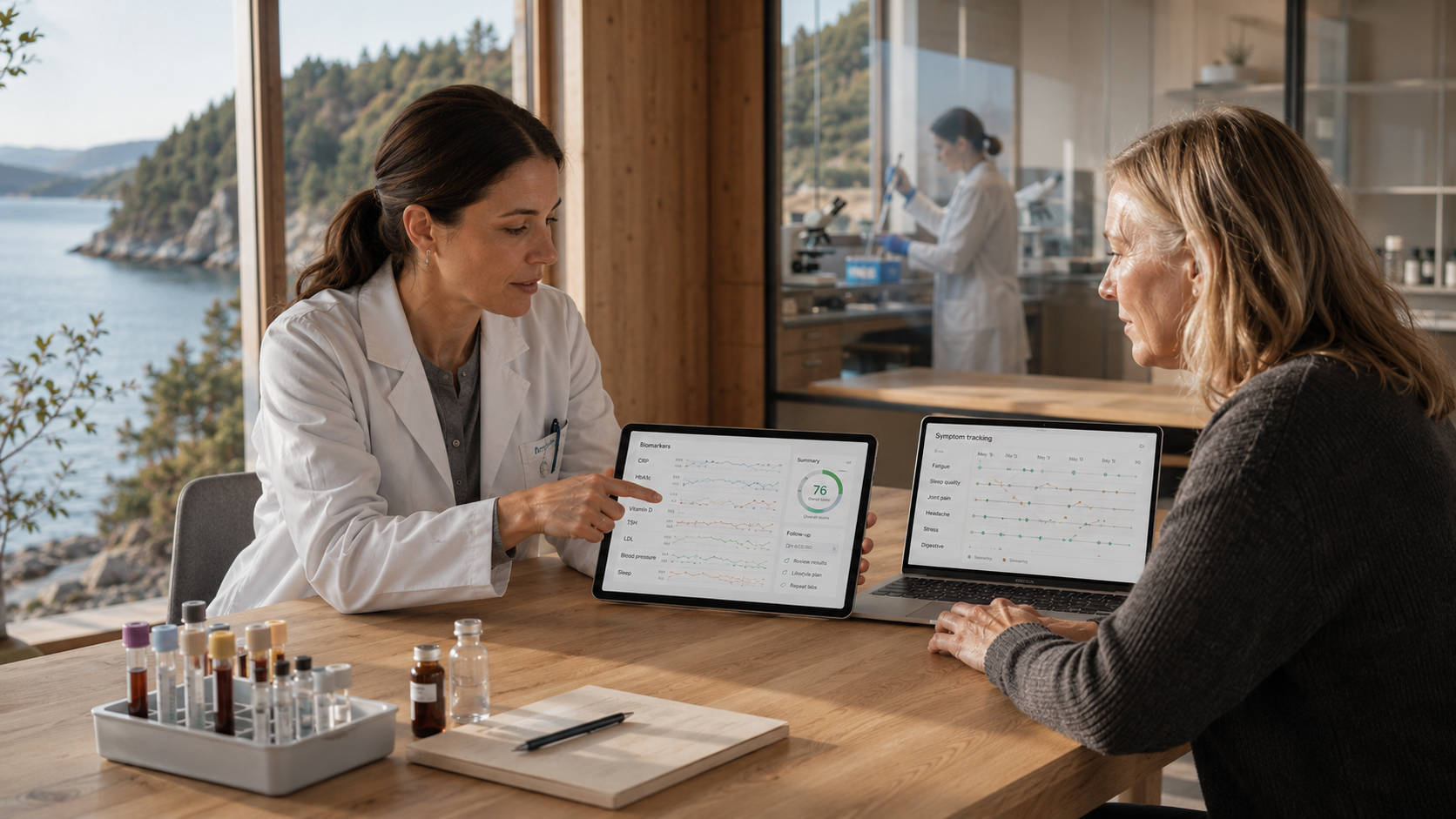
Diagnostics become more useful when they are linked to trends, symptoms, clinical context, AI-supported interpretation and expert judgment.
What counts as data?
In the Institute model, data can come from several sources.
Blood tests can show biological signals.
Symptom tracking can show how a person feels over time.
Medical history can explain risk and context.
Imaging can reveal structural changes.
Wearables can provide information about sleep, recovery, activity and physiology.
Lifestyle information can help interpret patterns.
Follow-up data can show whether something changed after an intervention or recommendation.
Real-world outcomes can help the Institute learn which patterns matter.
Each data source has limits.
But when the right sources are combined carefully, they can create a more useful picture than any single measurement alone.
Biomarkers as biological signals
Biomarkers are central to many of the Institute’s projects.
They can help measure inflammation, metabolism, cardiovascular risk, hormonal patterns, nutritional status, organ function, pregnancy development, recovery and long-term biological change.
In Longevity Intelligence, biomarkers may help identify risk patterns and guide long-term health strategies.
In Pregnancy Intelligence, biomarkers such as hCG and progesterone may help follow early pregnancy development together with symptoms and timing.
In Diagnostics Intelligence, biomarkers become part of a broader structure for testing, tracking and interpretation.
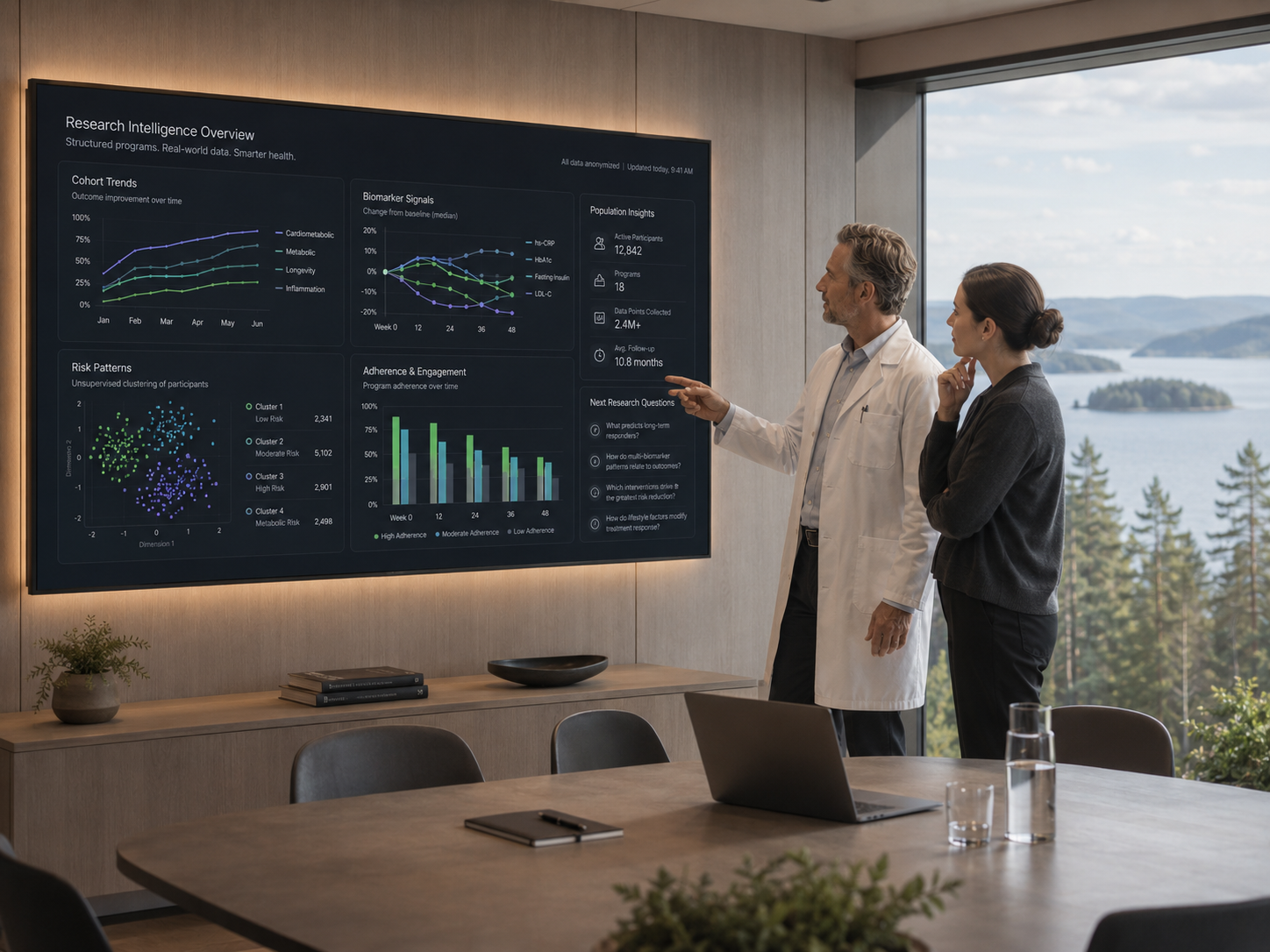
In Research Intelligence, biomarker patterns can contribute to model development and new research questions.
A biomarker is not meaningful only because it can be measured.
It becomes meaningful when it helps answer a relevant health question.
Symptoms and lived experience
Diagnostics should not be separated from how a person feels.
Symptoms, concerns, daily patterns and lived experience often provide essential context.
A blood test can show one part of the picture.
A symptom trend can show another.
For example, fatigue, pain, bleeding, sleep changes, recovery problems, nausea, stress, inflammation-related symptoms or pregnancy concerns may all become more meaningful when they are followed over time and connected to other data.
High Coast Health Intelligence Institute treats symptom tracking as part of the intelligence layer.
Not as a replacement for diagnostics.
But as an important complement.
Longitudinal tracking
Health changes over time.
That is why the Institute places strong emphasis on longitudinal tracking.
A single value can show where someone is today.
Repeated values can show direction.
Is the trend improving?
Is it stable?
Is it worsening?
Is it expected?
Is it unexpected?
Does it match the person’s symptoms or history?
Longitudinal tracking is especially important in areas such as longevity, prevention, pregnancy monitoring, metabolic health, inflammation, recovery and cardiovascular risk.
The goal is to understand patterns, not only moments.
Data with purpose
More data is not always better.
Too much unstructured information can create confusion, anxiety and poor decisions.
The Institute model is built around purposeful data.
Every measurement should have a reason.
What question does it answer?
What decision can it support?
What follow-up could it guide?
Who should interpret it?
What action could follow?
This is how diagnostics become health intelligence.
Without purpose, data remains noise.
With structure, data becomes useful.
AI-supported organization
Diagnostics and data can quickly become complex.
AI can help organize information, summarize trends, compare values, identify patterns and highlight signals that may need attention.
This is especially useful when multiple sources of data are combined:
biomarkers
symptoms
history
timing
wearables
previous results
program data
follow-up outcomes
AI can help prepare the information for interpretation.
But AI does not replace responsibility.
The Institute model combines AI-supported organization with human expertise, clinical caution and clear decision pathways.
Data quality and trust
Health intelligence depends on trustworthy data.
That means diagnostics must be reliable, traceable and clinically meaningful.
It also means data must be handled responsibly.
Privacy, consent, documentation, laboratory quality, interpretation standards and ethical use are essential.
The Institute’s ambition is not only to collect data.
It is to build a system where data can be trusted, interpreted and used in ways that create real value.
Poor data creates poor intelligence.
High-quality data creates a stronger foundation for better decisions.
Diagnostics across the Institute
Diagnostics and data support all major project areas.
In Longevity Intelligence, they help identify biological risk factors and guide long-term optimization.
In Pregnancy Intelligence, they help structure early monitoring and connect biomarker trends with symptoms and events.
In Research Intelligence, they help create responsible real-world datasets for pattern detection and model development.
In Diagnostics Intelligence, they form the central platform for testing, interpretation and follow-up.
Each project uses diagnostics differently.
But the principle is shared:
measure what matters, structure the information and use it to support better decisions.
The core idea
Diagnostics and data are not the end of the process.
They are the beginning of understanding.
High Coast Health Intelligence Institute uses diagnostics and structured data to make health questions measurable.
When data is collected with purpose, interpreted in context and followed over time, it can become health intelligence.
And health intelligence can support better decisions.