Longevity Intelligence
Healthspan, prevention and long-term biological understanding
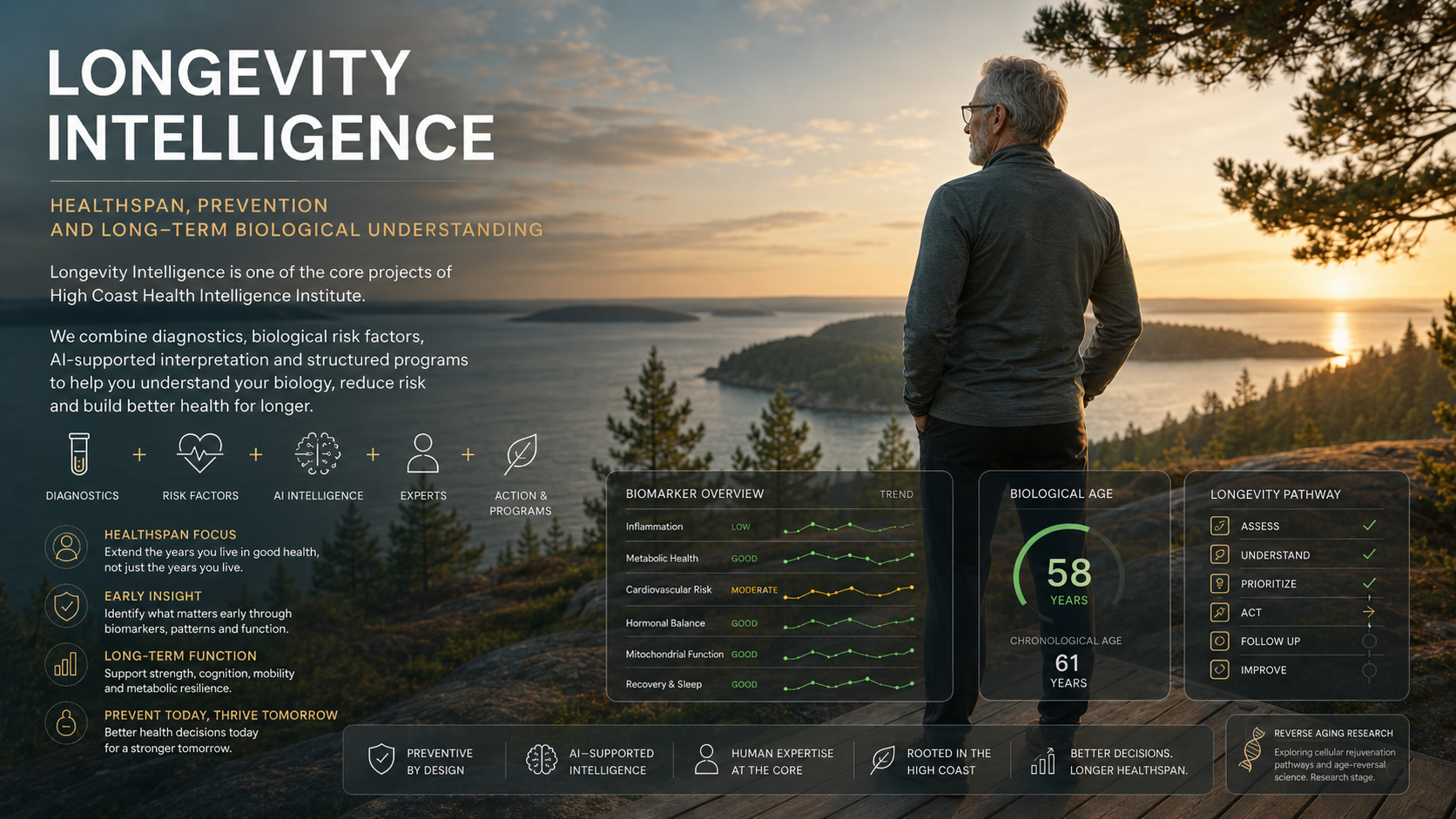
Longevity Intelligence is one of the core projects of High Coast Health Intelligence Institute.
It focuses on healthspan, prevention and long-term biological risk factors.
The purpose is not simply to help people live longer.
The purpose is to help people understand their biology earlier, identify meaningful risk patterns, make better health decisions and build structured strategies for long-term health.
Longevity Intelligence combines diagnostics, biomarker tracking, lifestyle context, AI-supported interpretation, expert knowledge, structured programs and follow-up over time.
It is where the Institute’s health intelligence model is applied to long-term human health.
Why longevity needs intelligence
Longevity is often discussed in broad or simplified terms.
- Supplements and Diets.
- Exercise trends.
- Biological age tests.
- Lifestyle advice.
- Anti-aging claims.
Some of these may be useful. Many are incomplete when used alone.
Real longevity work requires structure.
It requires understanding what is actually changing in the body, which risks matter most, what can be measured, what can be acted on and what should be followed over time.
High Coast Health Intelligence Institute approaches longevity through health intelligence.
That means connecting:
- biological signals
- diagnostics, symptoms and function
- lifestyle and recovery
- medical and family history
- AI-supported pattern recognition
- human expertise, structured programs, long-term follow-up
The goal is to move from general longevity interest to practical, measurable and responsible health decisions.
Healthspan and prevention
Longevity Intelligence is primarily focused on healthspan.
Healthspan means the period of life spent in good function, resilience and independence.
The central question is not only:
How long can we live?
The more practical question is:
How can we preserve health, function and quality of life for longer?
This requires a preventive approach.
Instead of waiting until disease is already established, Longevity Intelligence focuses on earlier signals, long-term patterns and modifiable risk factors.
The aim is to help people act before problems become larger, while still respecting medical boundaries and avoiding unnecessary overmedicalization.
Biological risk factors
Long-term health is shaped by many biological systems.
Longevity Intelligence focuses on biological risk factors that can often be measured, followed and improved.
These may include:
- inflammation, metabolic health, cardiovascular risk, hormonal balance
- nutritional status, organ function, body composition
- sleep and recovery, stress response, physical capacity
- biological age markers
A single marker rarely tells the whole story.
The value comes from understanding patterns across several systems.
- What appears stable?
- What is changing?
- What needs attention?
- What can be improved?
- What should be followed over time?
This is where diagnostics become intelligence.
Personalized diagnostics
Longevity Intelligence uses diagnostics as a foundation for more personalized understanding.
A useful longevity assessment should not only produce a list of lab values.
It should help identify priorities.
For one person, the most important area may be metabolic health.
For another, inflammation.
For another, cardiovascular risk, recovery, nutritional status, hormonal balance or physical performance.
Personalized diagnostics help answer:
Which biological systems are most relevant for this person?
Which markers should be followed?
Which findings are actionable?
Which results need expert interpretation?
Which changes would likely matter most?
The goal is not more testing for its own sake.
The goal is meaningful testing connected to decisions.
From data to action
Longevity data becomes useful only when it leads to action.
A biomarker panel, wearable signal or biological age estimate should not end as a static report.
It should support a pathway.
That pathway may include:
lifestyle priorities
nutrition and metabolic strategy
recovery and sleep routines
exercise direction
stress reduction
follow-up testing
expert consultation
structured health programs
retreat-based experiences
long-term tracking
Longevity Intelligence is designed to move from measurement to interpretation, and from interpretation to practical action.
AI-supported interpretation
Longevity data can quickly become complex.
AI-supported interpretation can help organize information, identify patterns, summarize trends and prepare decision support.
It can help show which systems may need attention, which markers appear stable and which changes should be followed over time.
But AI is not the final authority.
Longevity decisions require human judgment, clinical caution, scientific understanding and personal context.
At High Coast Health Intelligence Institute, AI supports the interpretation process.
It does not replace expertise.
Human expertise
Longevity Intelligence depends on expert knowledge.
Relevant expertise may include preventive medicine, diagnostics, physiology, nutrition, sleep, recovery, exercise, metabolic health, cardiovascular risk, research and program design.
The role of experts is to help interpret data responsibly and turn insight into realistic next steps.
A person should not be left alone with complex biological information.
The aim is to combine advanced data with human understanding.
Longevity programs
Longevity Intelligence can be delivered through structured programs.
These programs may include baseline assessments, advanced longevity assessments, recovery and performance tracks, retreat-based programs and long-term follow-up.
A program gives longevity work a practical format.
It allows a person to move through:
initial question or goal
diagnostic assessment
biological risk review
AI-supported interpretation
expert guidance
personalized action plan
follow-up over time
learning from outcomes
This makes longevity more than information.
It becomes a structured process.
High Coast longevity retreats
The High Coast provides a unique setting for longevity work.
Nature, space, seasonality, recovery and a low-noise environment can support the lived experience of long-term health programs.
At the same time, the environment is not presented as a solution by itself.
The High Coast becomes meaningful when combined with diagnostics, structured routines, expert guidance, follow-up and research.
Longevity retreats can become a format where science, environment and personal experience meet.
They can support reflection, recovery, education, diagnostics and practical health planning.
Research and learning
Longevity Intelligence is also part of the Institute’s research model.
Structured longevity programs can generate valuable real-world knowledge when data is collected responsibly and followed over time.
This can help identify:
which biomarkers matter most in context
which patterns predict change
which interventions appear useful
which groups respond differently
which models should be improved
which new products or programs should be developed
The goal is for longevity programs to become learning systems.
They should support the individual today while helping improve health intelligence for the future.
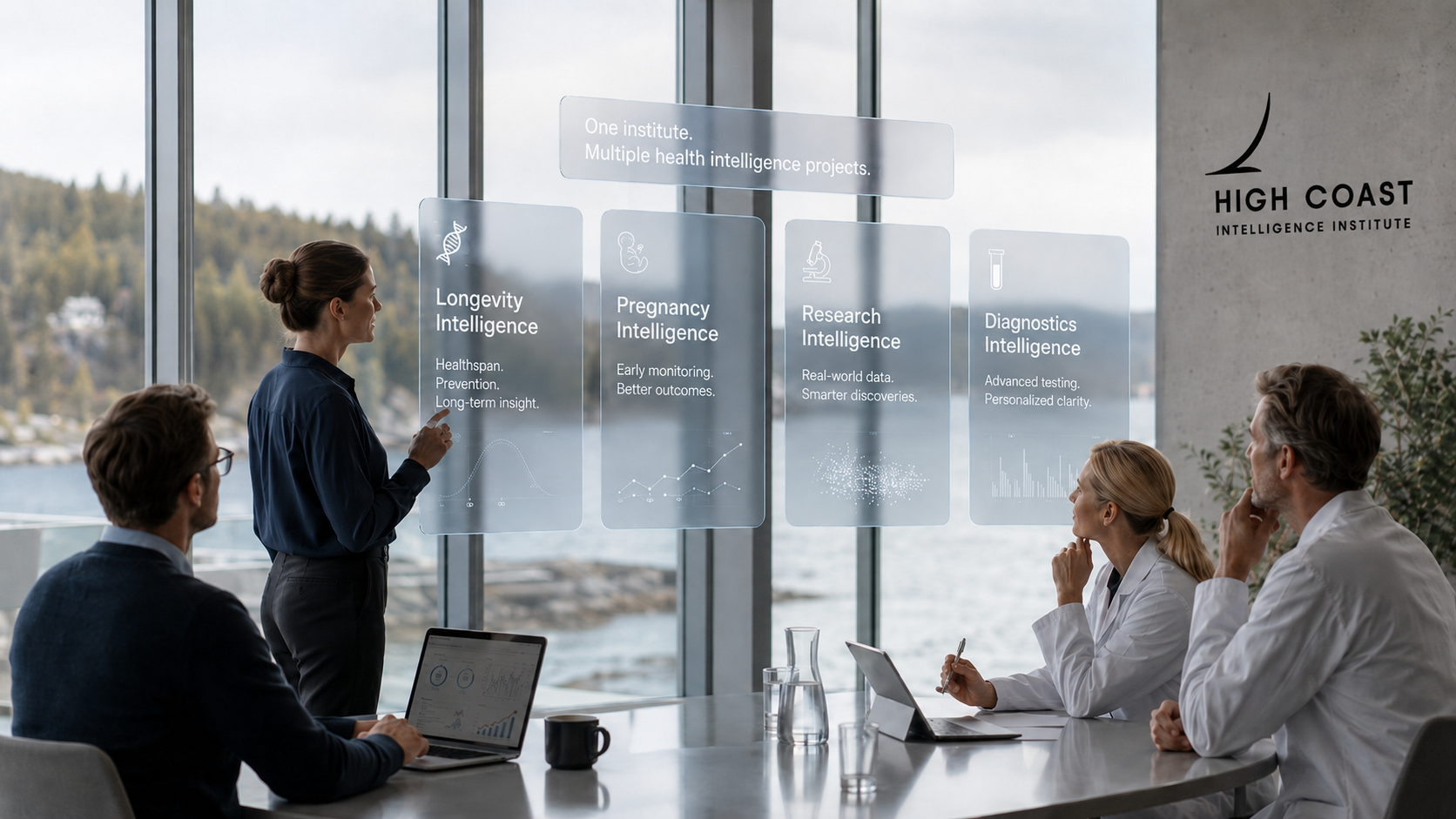
A project within the Institute
Longevity Intelligence is not the whole Institute.
It is one project area within High Coast Health Intelligence Institute.
It shares the same model as other Institute projects:
human need
diagnostics and data
AI intelligence layer
expert network
actionable health decisions
better outcomes and new knowledge
What makes Longevity Intelligence specific is its focus on long-term health, prevention, biological risk factors and healthspan.
The Institute provides the shared platform.
Longevity Intelligence provides one focused application.
The core idea
Longevity Intelligence is a structured approach to long-term health.
It connects diagnostics, biological risk factors, AI-supported interpretation, expert knowledge, programs, environment and follow-up.
The goal is to help people understand their health earlier, act more intelligently and build better strategies for healthspan over time.
Not just more longevity information.
Not just more tests.
Not generic advice.
Health intelligence for longer, better lives.