The Approach
How we think about preventive diagnostics
Diagnostics are most useful when they help answer a real health question.
At High Coast Health Intelligence Institute, diagnostics are not treated as isolated numbers, one-time tests or generic health checks.
They are part of a structured health intelligence model.
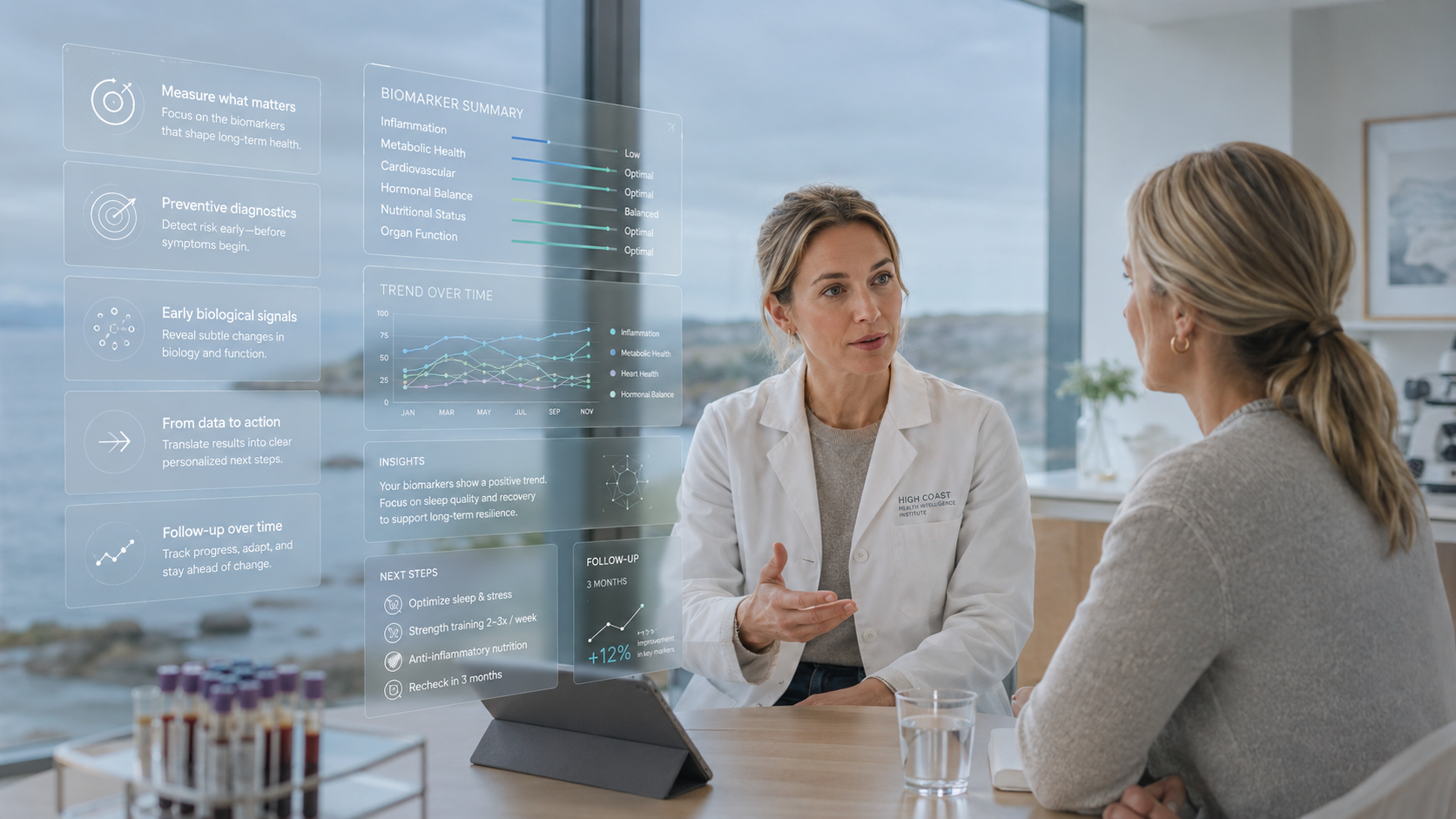
That means each diagnostic pathway should begin with a human need, measure what matters, identify relevant biological signals, support interpretation, lead to action and be followed over time.
The purpose is not simply to test more.
The purpose is to understand better.
Measure what matters
Modern diagnostics can measure more than ever before.
Blood markers, hormones, inflammation signals, metabolic markers, cardiovascular indicators, pregnancy biomarkers, organ function tests, wearable data and symptom patterns can all provide useful information.
But more data does not automatically create better decisions.
A test should have a purpose.
It should help answer a question such as:
What is changing?
What risk should be understood?
What should be followed?
What can be improved?
What needs expert review?
What decision can this support?
This is the first principle of the Institute’s diagnostic approach:
measure what matters.
Not everything that can be measured needs to be measured.
But the right measurement, in the right context, can become highly valuable.
Preventive diagnostics
Preventive diagnostics focus on understanding biological change before problems become larger.
This does not mean creating unnecessary worry or treating every variation as disease.
It means building better ways to identify risk patterns, follow relevant signals and support earlier action when action is meaningful.
Preventive diagnostics may help in areas such as:
long-term health and longevity
early pregnancy monitoring
metabolic health
inflammation and immune health
cardiovascular prevention
hormonal balance
nutritional status
recovery and performance
organ function
biological age and resilience
The goal is to make prevention more structured, measurable and practical.
A preventive diagnostic result should not only say what a value is.
It should help explain what the value may mean and what should happen next.
Early biological signals
Many health changes develop gradually.
Inflammation may rise over time.
Metabolic function may decline before symptoms are obvious.
Cardiovascular risk may build quietly.
Hormonal patterns may shift before they become clearly problematic.
Nutritional deficiencies may affect energy, recovery or function.
Pregnancy biomarkers may need to be understood as trends rather than isolated values.
Early biological signals can help create a clearer view of what is happening inside the body.
But early signals must be interpreted carefully.
A single marker rarely tells the whole story.
The value comes from context:
the person’s history
symptoms
timing
previous results
risk factors
trend direction
clinical relevance
follow-up
High Coast Health Intelligence Institute uses diagnostics to identify signals, but also to place those signals inside a structured interpretation model.
From data to action
Data should lead somewhere.
A diagnostic result may support reassurance, repeat testing, lifestyle guidance, expert interpretation, closer monitoring, clinical referral, program participation or research learning.
The key question is always:
What action can this information support?
A result without direction can create confusion.
A result connected to a pathway can create clarity.
That pathway may include:
measurement
context
trend analysis
AI-supported structure
expert interpretation
prioritization
recommendation
follow-up
This is how diagnostics move from data to action.
Follow-up over time
Diagnostics are most powerful when they are followed over time.
A single value is a snapshot.
A repeated value can show direction.
Is the marker stable?
Is it improving?
Is it worsening?
Is the change expected?
Does it match symptoms or history?
Did an intervention make a difference?
Should the next step change?
Longitudinal follow-up is central to the Institute’s diagnostic approach.
It is especially important in longevity, pregnancy monitoring, metabolic health, inflammation, cardiovascular prevention, recovery and structured health programs.
Follow-up turns diagnostics into learning.
It helps the individual understand change.
It helps experts make better decisions.
It helps the Institute improve future models.
Diagnostics as part of health intelligence
Diagnostics alone are not enough.
They become more useful when connected to other layers:
human need
symptoms
medical history
timing
lifestyle context
AI-supported interpretation
expert review
structured programs
follow-up outcomes
This is why the Institute uses the term Diagnostics & Data.
The diagnostic result is one part of a larger picture.
Health intelligence begins when these parts are connected.
AI-supported structure
AI can help organize diagnostic information.
It can summarize results, identify trends, compare patterns, detect changes and prepare structured interpretation.
This is especially useful when multiple data layers are involved:
biomarker panels
symptom reports
previous results
wearable data
pregnancy timing
lifestyle context
program outcomes
But AI is not the final authority.
The Institute uses AI as a support layer.
Human expertise remains important whenever findings are sensitive, uncertain, medically relevant or connected to important decisions.
Human expertise and clinical responsibility
Diagnostics require responsibility.
A person should not be left alone with complex results and unclear meaning.
Human expertise helps interpret what a finding means in context, what should be followed and when medical care may be needed.
At High Coast Health Intelligence Institute, diagnostics are designed to support better decisions, not replace healthcare responsibility.
The goal is to combine measurement, AI-supported structure and expert judgment into a more useful pathway.
A practical approach
The Institute’s diagnostic approach can be summarized in five steps:
start with a real health question
measure what matters
identify early biological signals
connect data to action
follow change over time
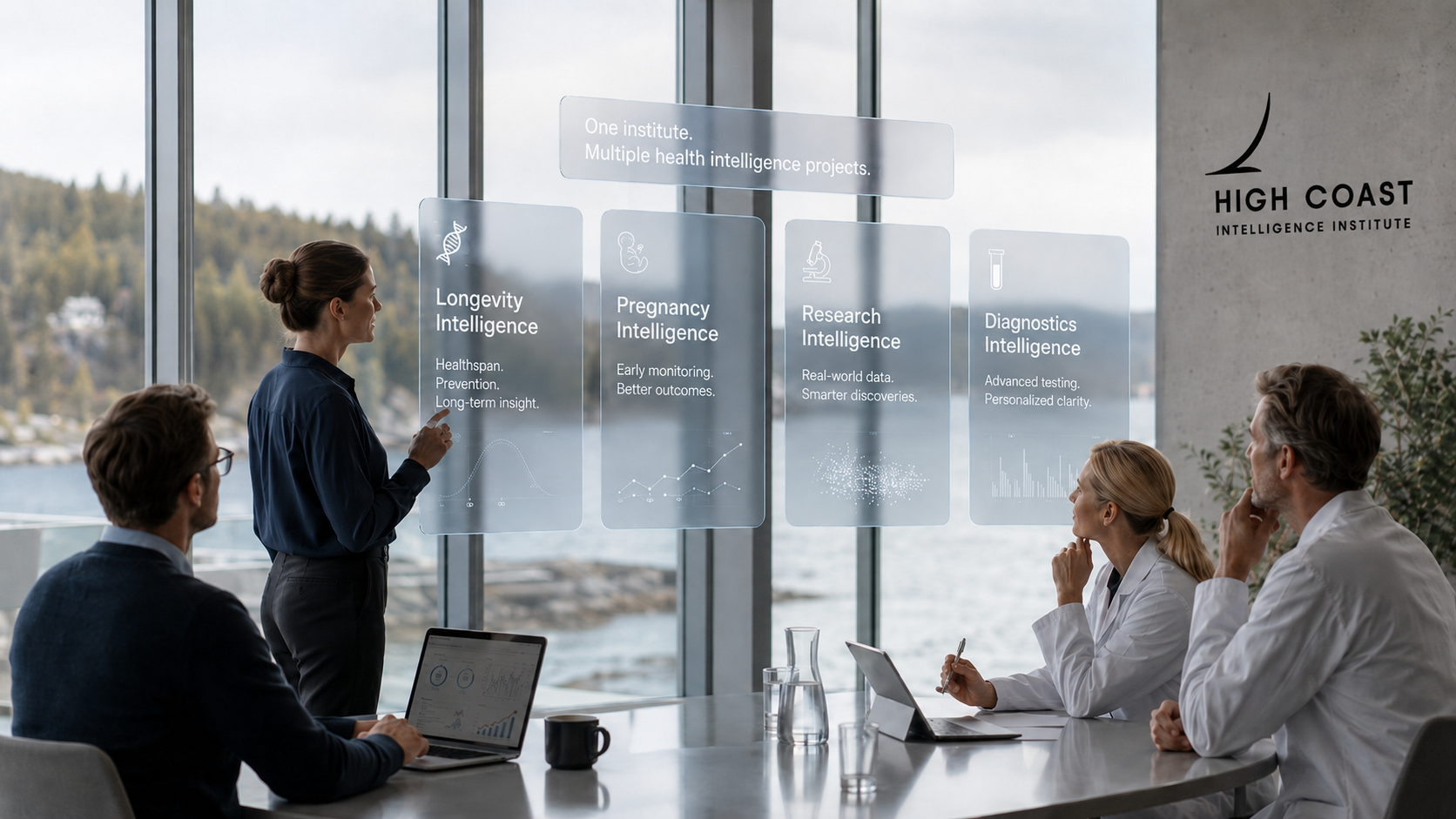
This approach can support multiple project areas:
Longevity Intelligence
Pregnancy Intelligence
Diagnostics Intelligence
Research Intelligence
future project areas in women’s health, metabolic health, inflammation, cardiovascular prevention, recovery and cognitive health
The same principles apply across different health needs.
The core idea
Diagnostics become useful when they become intelligence.
A test should not only produce a number.
It should help answer a question, reveal a pattern, guide a decision and support follow-up.
High Coast Health Intelligence Institute approaches diagnostics as part of a structured health intelligence system.
Measure what matters.
Interpret in context.
Act with clarity.
Follow over time.