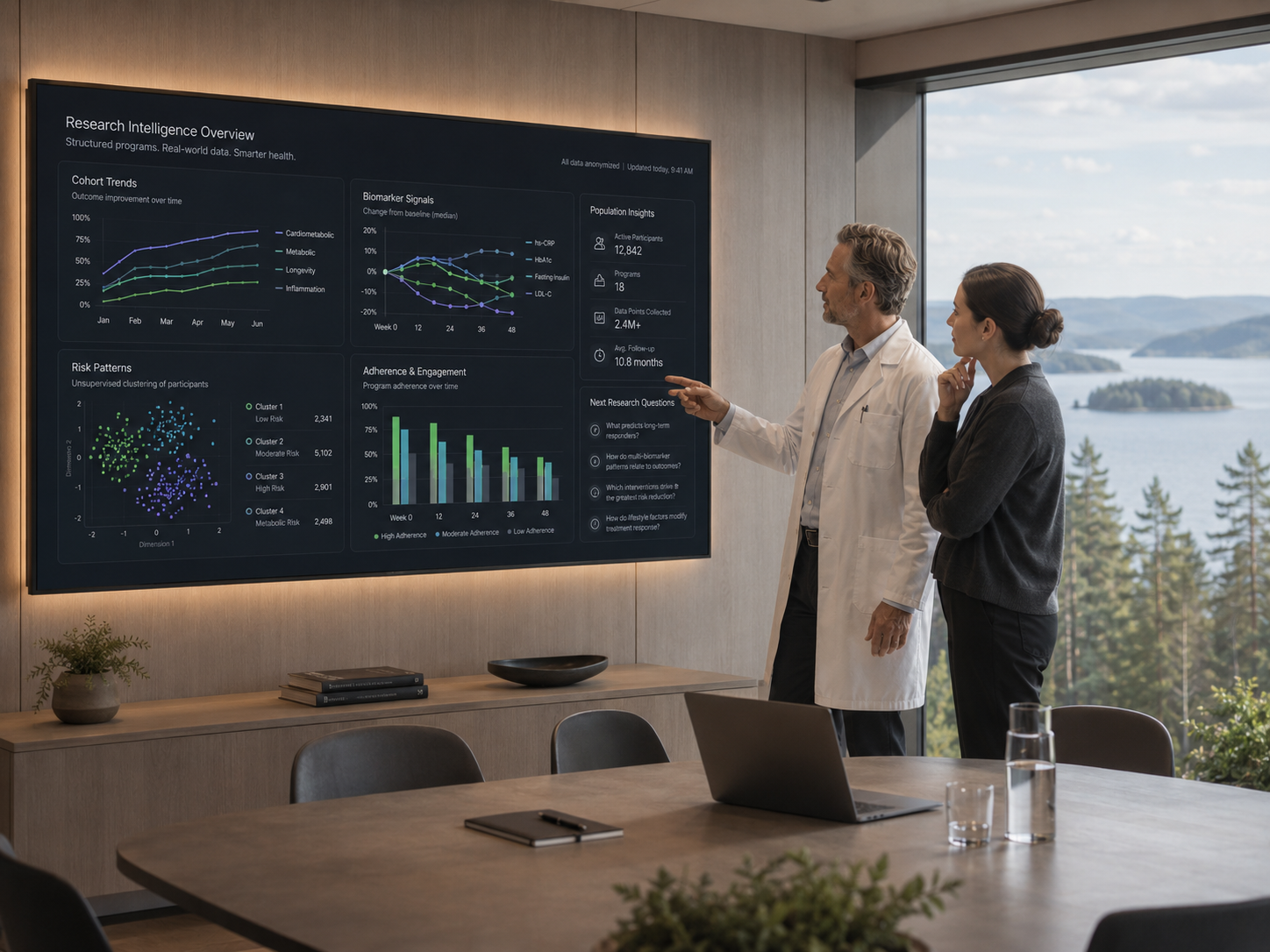
From single services to learning systems
Beyond isolated health services
Many health services are built as separate events.
A person takes a test.
A result is delivered.
A consultation happens.
A recommendation is given.
The process ends.
Each step may be useful, but the system often loses the larger pattern.
What happened before the test?
What changed after the recommendation?
Did the person improve, stabilize or need further support?
Which signals were meaningful?
Which patterns appeared across many people?
What could be learned for the next person?
High Coast Health Intelligence Institute is built around a different idea.
Health services should not only deliver information.
They should create learning.

The problem with disconnected events
A single health service can answer a single question.
But many important health challenges are not single moments.
Pregnancy development changes week by week.
Longevity and prevention depend on long-term patterns.
Inflammation, metabolism and recovery shift over time.
Symptoms may appear, disappear or return.
Risk factors may become more meaningful when they are followed.
When services are disconnected, important context disappears.
A laboratory may produce accurate results without knowing the outcome.
A clinician may make a recommendation without structured follow-up.
A digital tool may collect data without clinical interpretation.
A research idea may never be connected to real-world use.
This limits what can be learned.
What is a learning system?
A learning system is a structured model where each step contributes to better understanding.
It connects:
- human need
- diagnostics
- symptom and context data
- AI-supported interpretation
- expert review
- programs and interventions
- follow-up
- outcomes
- research and product development
The individual receives more structured support.
The Institute learns which patterns matter.
Clinicians and experts get better context.
Researchers can ask better questions.
Partners can develop better products.
Future participants can benefit from improved models.
This is the shift from a single service to a learning system.
Programs as intelligence loops
At High Coast Health Intelligence Institute, structured programs are designed as intelligence loops.
A person enters with a question, concern, risk factor or goal.
Relevant data is collected.
The information is structured and interpreted.
Experts are involved when needed.
A decision or recommendation is made.
Follow-up shows what happened next.
The outcome feeds back into the system.
Over time, the program becomes better at identifying which signals are important, which patterns need attention and which actions are most useful.
This is how health intelligence develops.
Learning across projects
The same logic can support several project areas.
- In Longevity Intelligence, a learning system can help identify long-term biological risk patterns and evaluate how lifestyle, recovery, diagnostics and programs affect healthspan.
- In Pregnancy Intelligence, a learning system can help structure early pregnancy monitoring, follow biomarker trends, connect symptoms with timing and identify which events should trigger closer follow-up.
- In Diagnostics Intelligence, a learning system can improve how tests are selected, combined, interpreted and followed over time.
- In Research Intelligence, a learning system can transform real-world programs into responsible sources of new knowledge, model development and product opportunities.
Each project has its own focus.
But they all share the same foundation: structured data, intelligent interpretation, expert involvement and follow-up.
Responsible learning
Learning from real-world health data must be done responsibly.
That means privacy, consent, clinical caution, data quality and clear boundaries.
The purpose is not to collect data without meaning.
The purpose is to build useful systems that respect people while creating better knowledge.
High Coast Health Intelligence Institute is designed around responsible health intelligence.
- Data should be collected with purpose.
- Interpretation should be transparent.
- AI should support, not replace, expert judgment.
- Research should follow ethical principles.
- Products should solve real problems.
A learning system must be trustworthy to be useful.
Why this matters
A learning system creates value at several levels.
- For individuals, it can provide clearer guidance and better follow-up.
- For clinicians, it can provide better context and decision support.
- For researchers, it can reveal real-world patterns that are difficult to see in isolated data.
- For laboratories, it can connect testing to meaningful interpretation and outcomes.
- For partners, it can create a platform for developing, testing and improving health products.
- For society, it can contribute to better preventive health models.
This is why the Institute is not built as a single service provider.
It is built as a platform for continuous improvement.
From service to system
The future of health will not only depend on more tests, more apps or more consultations.
It will depend on how well these parts are connected.
- A test becomes more useful when it is interpreted in context.
- A recommendation becomes more useful when it is followed.
- A program becomes more useful when it learns.
- A product becomes more useful when it is built around real human needs.
High Coast Health Intelligence Institute connects these parts into one structure.
The core idea
From single services to learning systems means that health programs should become smarter over time.
They should support the individual today while improving knowledge for tomorrow.
This is one of the central ideas behind High Coast Health Intelligence Institute.
Better structure creates better learning.
Better learning creates better decisions.
Better decisions can lead to better lives.