The model
A structured model for better health decisions
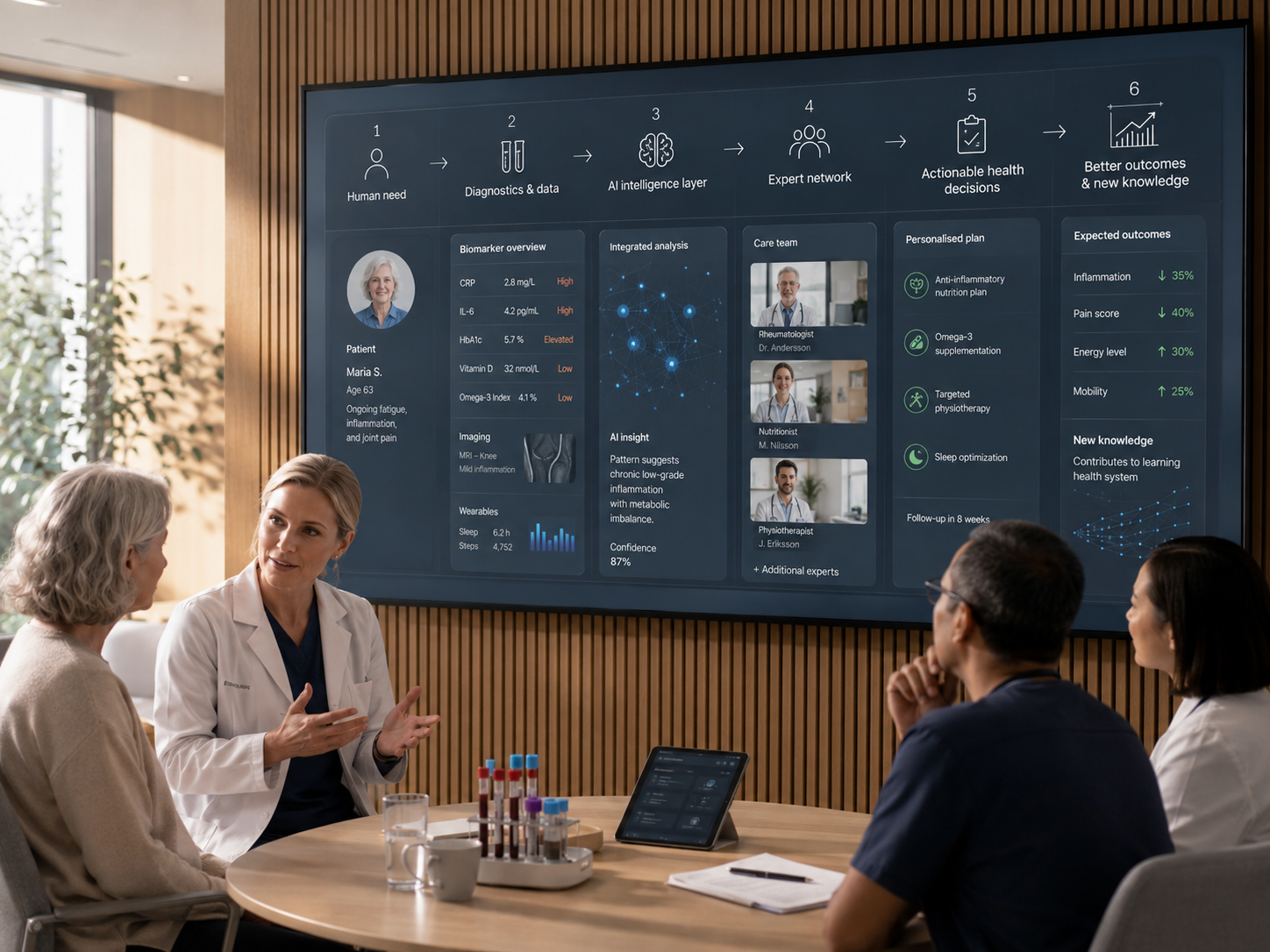
High Coast Health Intelligence Institute is built around a simple but powerful model:
- human need
- diagnostics and data
- AI intelligence layer
- expert network
- actionable health decisions
- better outcomes and new knowledge
This model describes how health questions can move from uncertainty to structure, from structure to interpretation, and from interpretation to action.
The purpose is not to collect more information for its own sake.
The purpose is to make health information useful.
A person may start with a concern, a risk factor, a symptom, a pregnancy history, a long-term health goal or a need for closer follow-up.
The Institute model turns that need into a structured process where relevant data is collected, interpreted, reviewed and translated into decisions that can be acted on.
Human need
The model starts with human need.
A health intelligence system should not begin with technology, tests or products.
It should begin with a real problem.
Someone wants to understand their long-term health.
Someone is worried during early pregnancy.
Someone has symptoms that need structure.
Someone wants to prevent future disease.
Someone needs better follow-up after a finding.
A clinician needs clearer decision support.
A researcher wants to understand real-world patterns.
Human need defines the direction of the model.
Without a clear need, diagnostics become scattered, AI becomes abstract and programs become generic.
The Institute starts by asking what question needs to be answered and what decision the answer should support.
Diagnostics and data
The next layer is diagnostics and data.
This includes blood tests, symptom tracking, clinical observations, imaging, wearable signals, lifestyle information, medical history and follow-up data.
Different projects require different types of data.
Longevity Intelligence may focus on inflammation, metabolic health, cardiovascular markers, biological age, recovery and lifestyle factors.
Pregnancy Intelligence may focus on hCG, progesterone, symptoms, bleeding episodes, timing, IVF history and previous pregnancy outcomes.
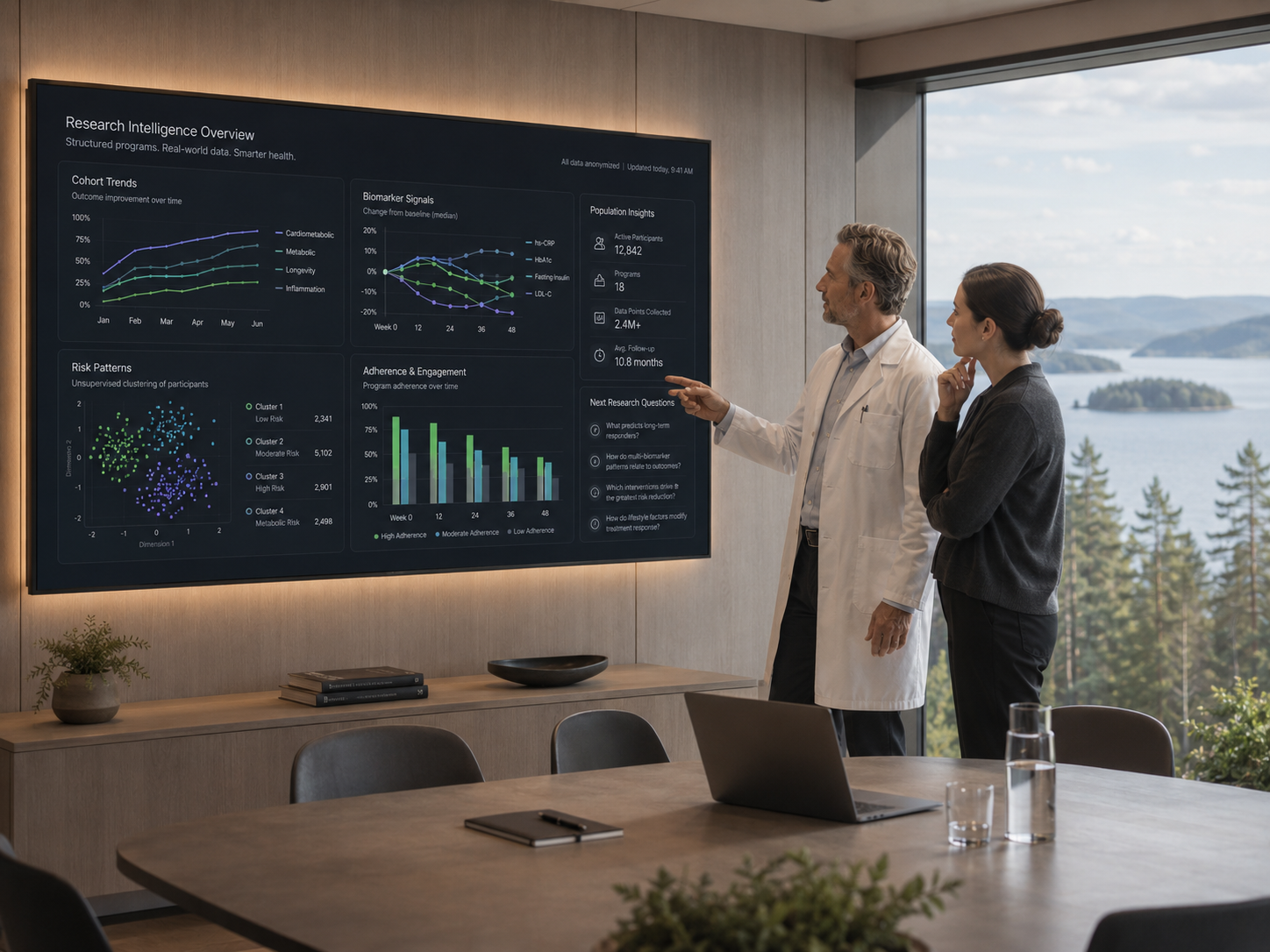
Research Intelligence may focus on structured real-world data across programs.
Diagnostics Intelligence supports the broader testing and interpretation structure across the Institute.
The key principle is simple:
measure what matters.
Data should be collected because it helps answer a meaningful question, not because it is possible to collect.
AI intelligence layer
The AI intelligence layer helps turn complex information into structure.
It can support trend analysis, pattern recognition, risk signals, summaries, prioritization and decision preparation.
AI can help answer questions such as:
What is changing over time?
Which signals appear stable?
Which values may need attention?
Which symptoms match the data pattern?
Which cases may need expert review?
Which follow-up step is reasonable?
This layer does not replace clinical or scientific judgment.
It supports it.
The role of AI is to help organize complexity, detect patterns and make information easier to interpret.
In the Institute model, AI is not a standalone product. It is part of a larger system that includes diagnostics, human expertise, ethics, follow-up and real-world learning.
Expert network
Health decisions require more than data and algorithms.
They require judgment.
That is why the Institute model includes an expert network of clinicians, researchers, laboratory specialists, data scientists, program developers and partner organizations.
Different needs require different expertise.
A pregnancy monitoring pathway may require medical interpretation and clear escalation routines.
A longevity program may require expertise in preventive medicine, diagnostics, physiology, nutrition, recovery and behavior change.
A research platform may require scientific design, data governance and ethical review.
A diagnostic program may require laboratory quality, clinical relevance and interpretation standards.
The expert network ensures that the model remains human, responsible and practical.
AI can help structure the question.
Experts help decide what the answer means.
Actionable health decisions
The model is only valuable if it leads to action.
Health intelligence should support clear next steps.
That may mean reassurance, follow-up, lifestyle guidance, further testing, expert consultation, clinical referral, program participation, research inclusion or product development.
The Institute does not aim to overwhelm people with information.
It aims to help answer:
What matters now?
What should be followed?
What can be improved?
What requires expert review?
What decision is reasonable?
What should happen next?
This is where diagnostics and data become useful.
They become part of a decision pathway.
Better outcomes and new knowledge
The final layer is learning.
When programs are structured and followed over time, they can generate new knowledge.
Outcomes can show what worked, what changed, what remained stable and what needs further investigation.
This creates value at several levels.
For individuals, it can mean clearer guidance and better follow-up.
For clinicians, it can mean better context and decision support.
For researchers, it can mean responsible real-world data and new questions.
For partners, it can mean better products and services.
For the Institute, it creates a continuous learning system.
Better outcomes and new knowledge are not separate from the model.
They are the reason the model exists.
A model that works across projects
The same structure can support multiple health intelligence projects.
In Longevity Intelligence, the model helps people understand biological risk factors, healthspan and long-term optimization.
In Pregnancy Intelligence, the model helps women follow early pregnancy signals, symptoms and trigger events with closer structure.
In Research Intelligence, the model helps transform real-world programs into pattern detection, model development and product opportunities.
In Diagnostics Intelligence, the model helps connect testing, tracking and interpretation across the platform.
Each project has its own content, but the architecture is shared.
Human need defines the problem.
Diagnostics and data make it measurable.
AI helps identify patterns.
Experts add judgment.
Programs create action.
Follow-up creates learning.
The model in one sentence
High Coast Health Intelligence Institute connects human need, diagnostics, data, AI, expert networks and structured programs to create better health decisions and new knowledge.
That is the model.
A practical health intelligence system, built in the High Coast, designed to support people, clinicians, researchers and partners across multiple health areas.