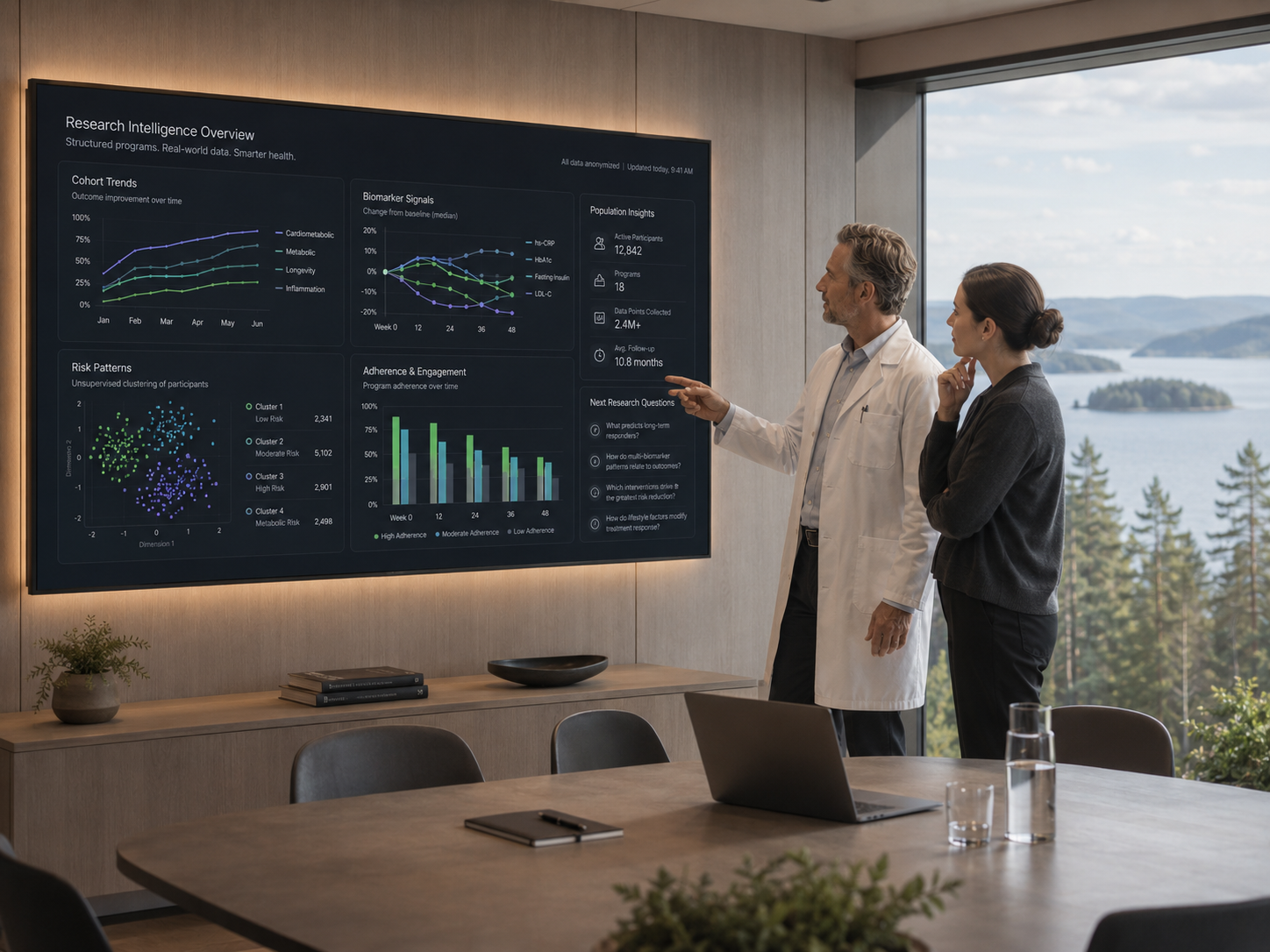
Research Intelligence
Turning real-world health programs into learning systems
Research Intelligence is one of the core projects of High Coast Health Intelligence Institute.
It focuses on turning structured health programs, diagnostics, real-world data and follow-up into better models, better decisions and new health products.
The idea is simple:
every structured health program should also become a learning system.
When people move through diagnostics, symptom tracking, AI-supported interpretation, expert guidance, programs and follow-up, valuable patterns can emerge.
Those patterns can help improve future decisions.
They can also help develop better diagnostics, better monitoring systems, better programs and better products.
Research Intelligence is where the Institute’s health intelligence model becomes a continuous learning platform.
Why research intelligence matters
Many health services are built as isolated events.
A test is taken.
A result is delivered.
A recommendation is given.
The process ends.
This can be useful for the individual moment, but it often loses the larger learning opportunity.
What happened after the recommendation?
Did the biomarker trend improve?
Did symptoms change?
Was follow-up needed?
Which patterns appeared across many people?
Which signals mattered most?
Which products or tools should exist but do not?
Research Intelligence is built to ask these questions systematically.
The goal is not only to provide a service.
The goal is to learn from structured health pathways over time.
Real-world data
Research Intelligence is based on real-world data.
This means information that comes from actual health programs, diagnostics, symptom tracking, follow-up and outcomes.
Real-world data can include:
biomarkers
symptom reports
medical history
pregnancy monitoring data
longevity assessments
lifestyle and recovery data
trigger events
program participation
follow-up results
outcome patterns
This kind of data can be highly valuable because it reflects real human needs and real decisions.
But it must be handled responsibly.
Research Intelligence is built around structured, consent-based and purpose-driven data use.
The goal is not to collect data for its own sake.
The goal is to create knowledge that can improve health decisions.
Learning health systems
A learning health system is a system that improves through use.
Each structured program can support the individual today while also helping improve the model for future participants.
This is central to High Coast Health Intelligence Institute.
In Pregnancy Intelligence, structured monitoring may help identify which trends, symptoms or trigger events need closer attention.
In Longevity Intelligence, long-term follow-up may help identify which biomarker patterns and interventions are most meaningful for healthspan.
In Diagnostics Intelligence, repeated use may help improve which panels, markers and interpretation models are most useful.
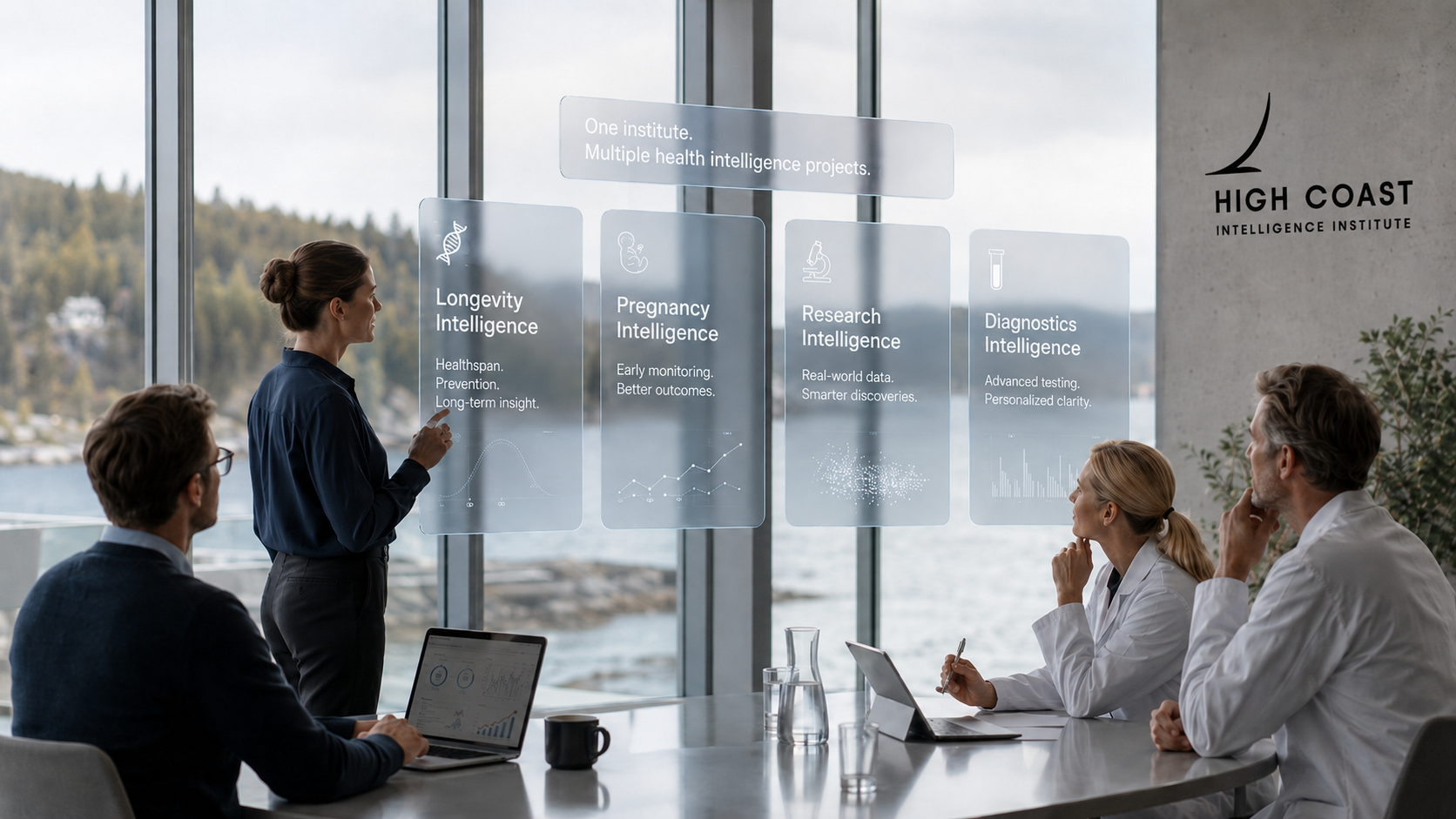
Research Intelligence connects these project areas into a broader learning system.
Each project has its own focus.
But together, they can create shared knowledge.
Pattern detection
Pattern detection is one of the main functions of Research Intelligence.
Many important health signals are not visible in a single test or single consultation.
They become visible over time.
A biomarker trend may matter more than a single value.
A symptom pattern may become meaningful when connected to timing.
A trigger event may reveal when closer follow-up is needed.
A response to a program may show which interventions are most useful for which people.
Research Intelligence looks for these patterns.
Important questions may include:
Which early signals predict later outcomes?
Which biomarkers are most useful in context?
Which symptoms should trigger closer review?
Which combinations of data improve interpretation?
Which follow-up pathways create better decisions?
Which groups respond differently to the same intervention?
Pattern detection helps move health intelligence from observation to understanding.
Model development
Research Intelligence also focuses on model development.
A model can help structure decisions, identify risk patterns, support follow-up or guide program design.
The Institute may develop models for:
risk stratification
trend analysis
trigger-event detection
decision support
program optimization
biomarker interpretation
pregnancy monitoring pathways
longevity assessment pathways
The purpose is not to create abstract models disconnected from real life.
The purpose is to develop models that help people, clinicians, researchers and partners make better decisions.
A model should be useful.
It should be understandable enough to support trust.
It should be improved through real-world follow-up.
New product opportunities
Research Intelligence is not only about analysis.
It is also about identifying what should be built.
When real-world health programs reveal repeated needs, those needs can become product opportunities.
A repeated problem may suggest a new digital monitoring tool.
A common confusion may suggest a better interpretation system.
A missing follow-up pathway may suggest a new program.
A diagnostic pattern may suggest a new testing panel.
A research insight may suggest a partner product.
This is one of the reasons Research Intelligence is important to the Institute.
It connects health needs with product development.
The goal is to build products that solve real problems, not products that exist only because technology makes them possible.
Research Intelligence in pregnancy monitoring
Pregnancy Intelligence can generate important research questions.
Early pregnancy is a dynamic and emotionally sensitive period.
Structured monitoring can help explore questions such as:
How do hCG and progesterone trends vary across different situations?
Which symptoms create the most concern?
Which bleeding patterns require closer follow-up?
How should IVF history affect monitoring pathways?
When does structured information reduce anxiety?
When is human expertise most important?
Research Intelligence can help improve pregnancy monitoring models over time.
The aim is not to promise certainty.
The aim is to build better structure, better context and better decision support.
Research Intelligence in longevity
Longevity Intelligence can also become a rich learning system.
Long-term health depends on many biological systems:
inflammation
metabolic health
cardiovascular markers
hormonal balance
nutritional status
sleep and recovery
physical capacity
biological age markers
Research Intelligence can help identify which patterns matter most, which changes are meaningful and which interventions seem to create measurable improvement.
This can support better healthspan programs, better diagnostics and more useful longevity products.
Research Intelligence in diagnostics
Diagnostics Intelligence and Research Intelligence are closely connected.
Diagnostics generate biological signals.
Research Intelligence helps understand which signals matter in context.
A biomarker panel becomes more valuable when it can be connected to symptoms, history, follow-up and outcomes.
Over time, Research Intelligence can help answer:
Which markers should be included?
Which combinations create better interpretation?
Which tests are useful for prevention?
Which results need expert review?
Which follow-up intervals make sense?
This can help diagnostics evolve from isolated testing into structured health intelligence.
Responsible data and ethics
Research Intelligence depends on trust.
Health data is sensitive.
Pregnancy data is sensitive.
Longitudinal data is sensitive.
AI-supported interpretation can influence decisions.
Therefore, responsible data use is central to the project.
This means:
clear purpose
consent-based data use
privacy protection
appropriate anonymization
clinical caution
human oversight
research governance
responsible AI
The Institute’s goal is to build learning systems that respect people while improving knowledge.
Trust is not optional.
It is part of the infrastructure.
Human expertise and AI
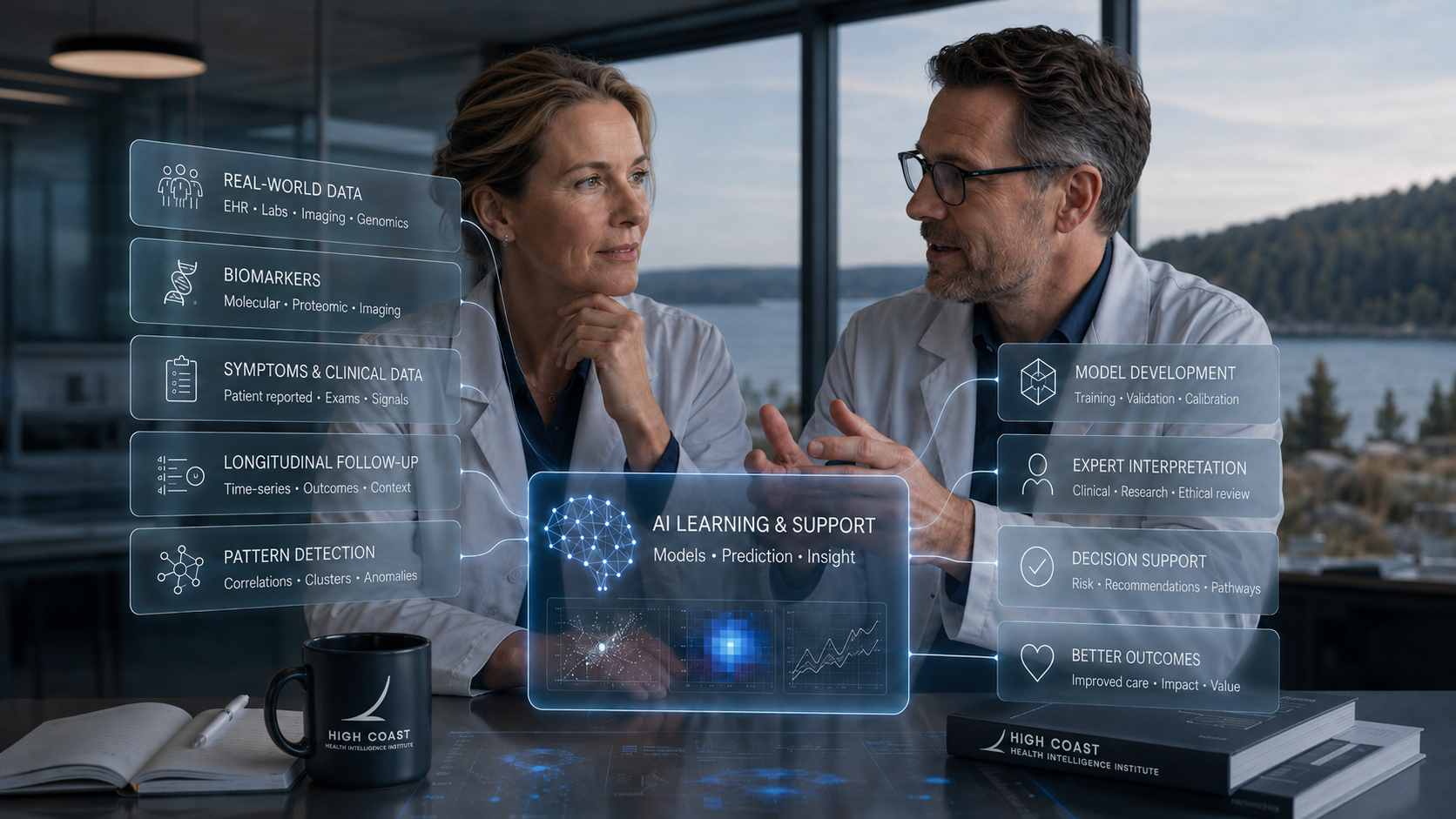
AI can help identify patterns, structure data, summarize trends and support model development.
But AI is not enough.
Research Intelligence requires human expertise.
Researchers, clinicians, laboratory specialists, data scientists and project experts are needed to ask the right questions, evaluate findings and understand limitations.
AI can help find patterns.
Human expertise helps decide what those patterns mean.
This balance is especially important in health.
From learning to better decisions
Research Intelligence becomes valuable when learning improves decisions.
That may mean:
better monitoring pathways
better interpretation models
better diagnostic panels
better follow-up routines
better program design
better clinical decision support
better partner products
better public education
Research should not stay abstract.
It should return to the health intelligence model and improve what happens next.
This is the loop:
real-world data creates patterns
patterns create models
models support decisions
decisions create outcomes
outcomes create new learning
A project within the Institute
Research Intelligence is one project within High Coast Health Intelligence Institute.
It shares the same model as the other Institute projects:
human need
diagnostics and data
AI intelligence layer
expert network
actionable health decisions
better outcomes and new knowledge
What makes Research Intelligence specific is its focus on learning, pattern detection, model development and product creation.
It helps the whole Institute become smarter over time.
The core idea
Research Intelligence turns structured health programs into learning systems.
It connects real-world data, diagnostics, AI-supported analysis, expert interpretation, follow-up and outcomes.
The goal is to identify patterns, build better models and create new products that solve important health problems.
Not research separated from practice.
Not data without purpose.
Practical learning from real-world health intelligence.