
Research
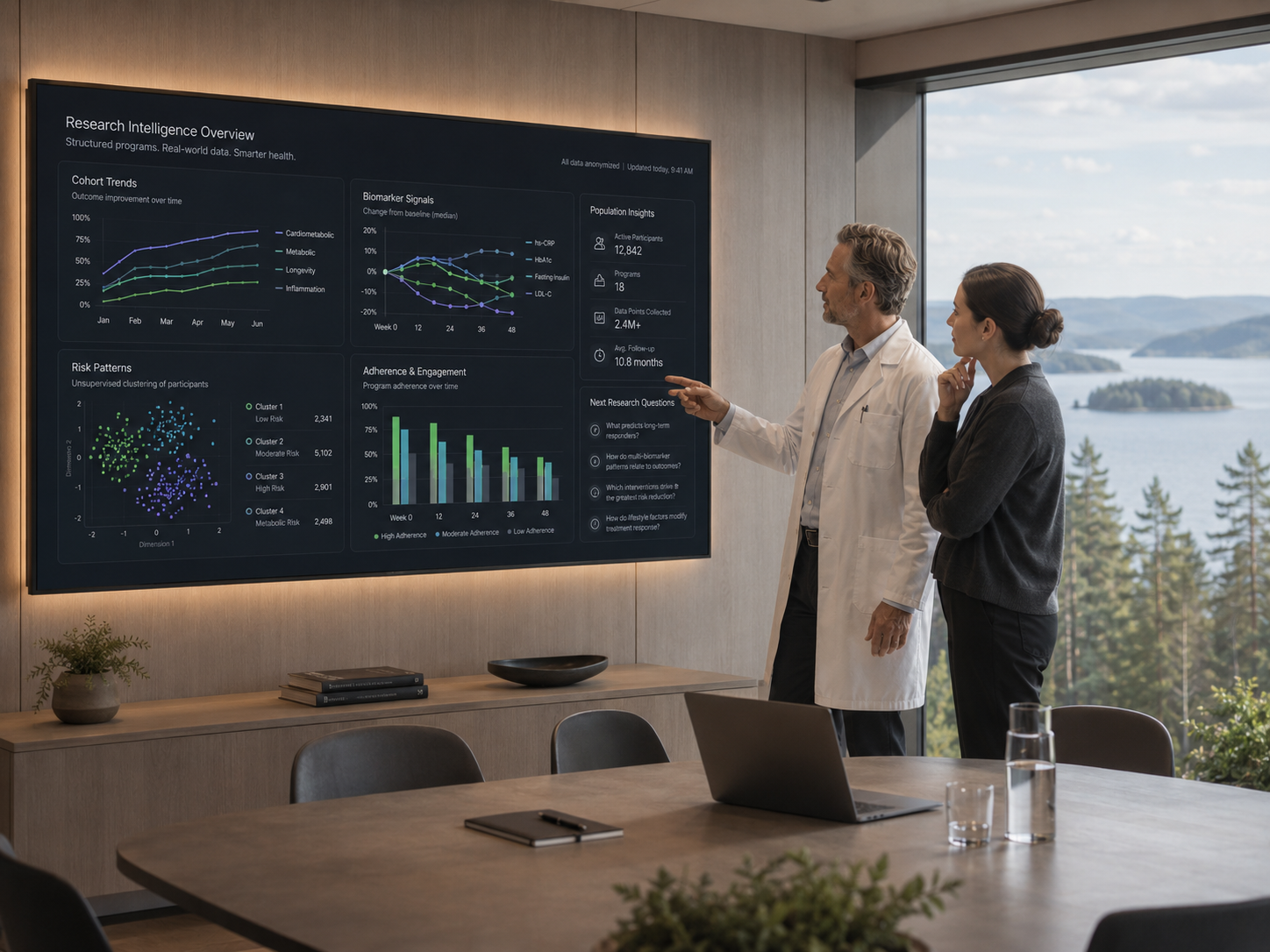
From real-world data to better health decisions
Research at High Coast Health Intelligence Institute is not treated as something separate from practice.
It is built into the Institute model.
When diagnostics, structured programs, expert interpretation and follow-up are connected over time, they create more than individual services.
They create the possibility to learn.
This is the role of research within the Institute:
to turn real-world data into better understanding, better models, better decisions and, over time, better health products and systems.
The aim is not research for its own sake.
The aim is practical research that helps improve how health intelligence is developed and used.
Research as part of the Institute model
Every project in the Institute can generate research questions.
Longevity Intelligence can help explore healthspan, biological risk factors, prevention and long-term follow-up.
Pregnancy Intelligence can help explore early pregnancy monitoring, symptom patterns, trigger events and structured support.
Diagnostics Intelligence can help explore biomarkers, testing systems, interpretation frameworks and longitudinal measurement.
Future projects may contribute knowledge in areas such as metabolic health, inflammation, women’s health, cardiovascular prevention, recovery and cognitive health.
This means research is not one isolated department.
It is a shared function across the Institute.
Programs can become learning systems.
Diagnostics can become structured data sources.
Expert decisions can become better over time.
Real-world experience can become new knowledge.
Research intelligence
The Institute’s research model begins with the idea of research intelligence.
This means using structured, responsibly collected data to identify patterns, improve models and guide future development.
The purpose is to move from isolated observations to more meaningful understanding.
Research intelligence can include:
- programs as learning systems
- responsible real-world data
- pattern discovery
- better models
- new health products
The point is not only to observe what happened.
The point is to ask what can be learned, improved, validated or built next.
Programs as learning systems
A health program becomes more valuable when it learns over time.
A participant may enter a program for a personal reason:
- to understand long-term health risk
- to monitor an early pregnancy
- to gain clarity from diagnostics
- to improve recovery or performance
- to receive more structured follow-up
The first responsibility is always to that individual.
But if data is collected responsibly and followed over time, the program can also contribute to broader learning.
Patterns may emerge.
Some biomarkers may prove more useful than expected.
Certain follow-up pathways may work better.
Different people may respond differently to similar recommendations.
Programs can therefore become learning systems.
This is one of the Institute’s core research ideas.
Responsible real-world data
The Institute’s research approach depends on real-world data.
This includes data that comes from programs, diagnostics, symptom tracking, follow-up, AI-supported interpretation and outcome observation.
Real-world data matters because it reflects how health questions appear outside highly controlled research settings.
It can help identify patterns that are practical, relevant and close to real human needs.
But this must be done responsibly.
The Institute’s ambition is not to collect data for its own sake.
It is to work with consent-based, structured and meaningful data use.
Research should improve understanding while respecting privacy, trust and ethical boundaries.
Pattern discovery
Many important health signals do not appear as obvious one-time events.
They emerge across time, across repeated measurements and across combinations of data.
Pattern discovery is therefore central to research at the Institute.
This may involve questions such as:
Which biomarker patterns predict change over time?
Which symptoms matter most in context?
Which trigger events deserve faster response?
Which combinations of data improve interpretation?
Which follow-up pathways lead to better outcomes?
Which groups respond differently?
Pattern discovery is one of the main ways that research intelligence creates value.
It helps move from scattered information to structured insight.
Better models
A core purpose of research is model development. The Institute does not only want to provide services. It wants to build better models for understanding and supporting health.
This may include:
- prediction models
- risk stratification
- trend analysis
- trigger-event detection
- decision support systems
Some models may support clinicians.
Some may support participants.
Some may support program design.
Some may support future research or product development.
The important point is that models should grow out of real needs, real data and responsible interpretation.
They should not be abstract tools disconnected from practice.
Research areas
The Institute’s research can grow across several research areas.
These may include:
- longevity and healthspan
- pregnancy monitoring
- inflammation and immune health
- metabolic health
- preventive diagnostics
- AI-supported clinical interpretation
These areas are not separate silos.
They are overlapping domains within a broader health intelligence framework.
Some questions begin in one project and become relevant to others.
A research platform should make that cross-learning possible.
Data and ethics
Research quality depends not only on data, but on how data is handled. This is why data and ethics are central to the Institute’s research approach.
Important principles include:
- consent-based data use
- privacy and anonymization
- responsible AI
- clinical safety
- research governance
The Institute’s goal is to create useful and scalable learning systems without losing trust.
- Health data is sensitive.
- Pregnancy data is sensitive.
- Longitudinal data is sensitive.
- AI-supported interpretation can affect decisions.
This is why governance matters. Responsible research is not a side issue. It is part of the foundation.
Responsible AI in research
AI can help structure data, identify patterns, support trend analysis and generate more useful decision tools.
But AI should not be treated as automatically trustworthy.
It must be evaluated in context.
Responsible AI in research means asking:
- Is the pattern meaningful?
- Is the model useful?
- Is the output clinically safe?
- Can the result support better decisions?
- Are the limitations understood?
- Is human oversight still present?
The Institute’s research model is built on the idea that AI should support research intelligence, not replace scientific or clinical judgment.
Publications and science
Research should eventually become visible and shareable.
Over time, the Institute may publish:
- articles
- white papers
- research notes
- scientific collaborations
- open questions and concept papers
Not every insight needs to become a formal publication immediately.
But a serious research platform should contribute to broader knowledge, not only internal development.
Publications and collaborations help connect the Institute to science, healthcare, partners and future innovation work.
They also help demonstrate that the Institute is building something deeper than a single product or service.
New health products
One important research outcome is the creation of new health products and systems.
Research should not only describe problems.
It should help make solutions possible.
This may include:
- better program models
- new diagnostics pathways
- decision support systems
- monitoring tools
- partner products
- AI-supported interpretation models
- structured follow-up platforms
This is one of the reasons the Institute links research so closely to projects and diagnostics.
The distance from insight to application should be shorter.
Why research matters
Research matters because health intelligence should improve over time.
A static system is limited.
A learning system can become better.
- It can ask better questions.
- It can measure more meaningfully.
- It can interpret more responsibly.
- It can design better programs.
- It can support better decisions.
This is the broader purpose of research at High Coast Health Intelligence Institute.
To help transform practice into learning, and learning into better health intelligence.
The core idea
Research at High Coast Health Intelligence Institute is built around one central principle:
real-world health programs should also become learning systems.
By combining diagnostics, structured follow-up, responsible data use, expert interpretation and model development, the Institute can create research that is both practical and ambitious.
The goal is not only to collect knowledge.
The goal is to use knowledge to improve decisions, models, programs and future health products.
From real-world data to better health decisions.