Actionable health decisions
From insight to action
Actionable health decisions are the fifth layer of the High Coast Health Intelligence Institute model.
Human need defines the question.
Diagnostics and data make the question measurable.
The AI intelligence layer helps structure information and identify patterns.
The expert network adds judgment, responsibility and interpretation.
But the model only becomes valuable when insight leads to action.
Health intelligence should not end with a report, a dashboard or a list of results.
It should help answer a practical question:
What should happen next?
Why action matters
Health information can be useful, but it can also create uncertainty.
A person may receive test results and still not know what to do.
A trend may be visible, but not translated into a clear next step.
A symptom may be tracked, but not connected to a decision.
An AI summary may identify a pattern, but the person still needs guidance.
High Coast Health Intelligence Institute exists to close the gap between understanding and action.
The goal is not simply to explain health data.
The goal is to support better health decisions.
What makes a decision actionable?
A decision becomes actionable when it is clear, relevant and possible to follow.
It should help define:
what matters now
what can be monitored
what should be improved
what needs expert review
what should be tested again
what can be safely observed
what should be escalated
what follow-up should happen next
Actionable does not always mean dramatic.
Sometimes the best decision is reassurance.
Sometimes it is waiting and repeating a test.
Sometimes it is lifestyle change.
Sometimes it is referral, closer monitoring or a structured program.
The important point is that the person should not be left with information without direction.
Decisions across different levels
Actionable health decisions can happen at several levels.
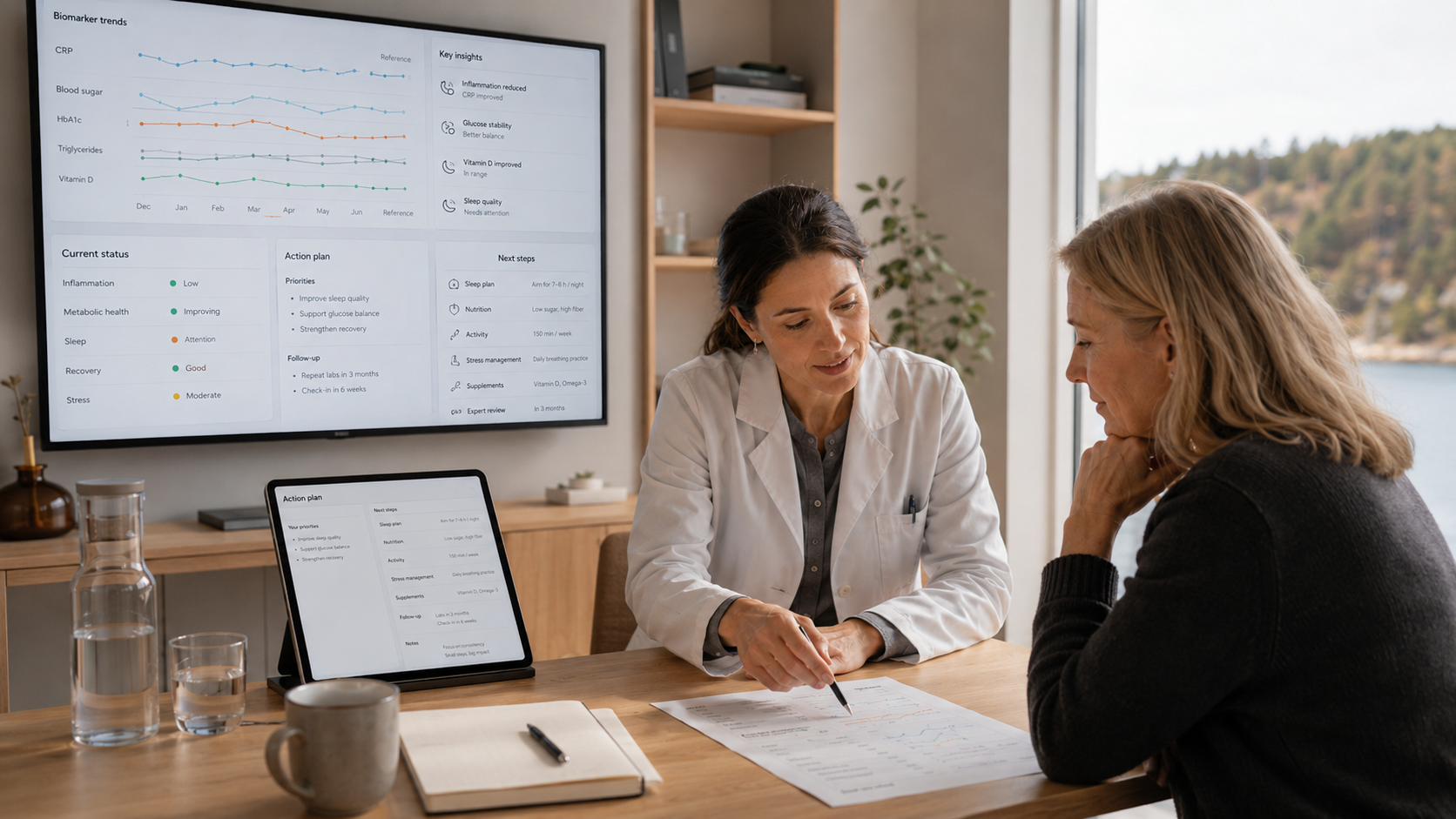
For an individual, it may mean a personalized health plan, a follow-up schedule, a recommendation to contact healthcare, or a decision to monitor a trend.
For a clinician, it may mean a clearer overview of what needs attention.
For a researcher, it may mean identifying a pattern that should be studied further.
For a partner, it may mean developing a product, diagnostic pathway or program around a real need.
For the Institute, it means turning insight into structured pathways that can improve over time.
Health intelligence should create movement.
From concern to measurement.
From measurement to interpretation.
From interpretation to decision.
From decision to follow-up.
From follow-up to learning.
Action in Longevity Intelligence
In Longevity Intelligence, actionable decisions may focus on long-term healthspan and prevention.
A person may learn that inflammation, metabolic health, cardiovascular markers, recovery, sleep, nutritional status or biological risk factors need attention.
The next step should not be a vague recommendation.
It should become a structured plan.
That may include targeted diagnostics, lifestyle priorities, recovery routines, nutrition guidance, exercise direction, follow-up testing, expert consultation or a longer program.
The purpose is to help people move from knowing their risk factors to acting on them.
Action in Pregnancy Intelligence
In Pregnancy Intelligence, action must be especially careful.
Early pregnancy monitoring can provide structure, but it cannot remove all uncertainty.
A decision may involve continued monitoring, repeat testing, symptom tracking, reassurance, escalation to healthcare or expert review.
The purpose is not to replace emergency care, maternity care or clinical responsibility.
The purpose is to support clearer decisions during a sensitive period.
For women with IVF history, previous miscarriage, bleeding episodes or high concern, structured follow-up can help reduce confusion and clarify when the next step is needed.
Action in this context must be calm, responsible and clearly connected to medical boundaries.
Action in Diagnostics Intelligence
In Diagnostics Intelligence, actionable decisions are built into the testing process.
A biomarker should not only be measured.
It should support a decision.
Should it be repeated?
Should it be combined with another marker?
Should it trigger a review?
Should it become part of a program?
Should it lead to lifestyle guidance?
Should it be interpreted as stable, improving or concerning?
Diagnostics become more valuable when each result is connected to a possible next step.
This is how testing becomes health intelligence.
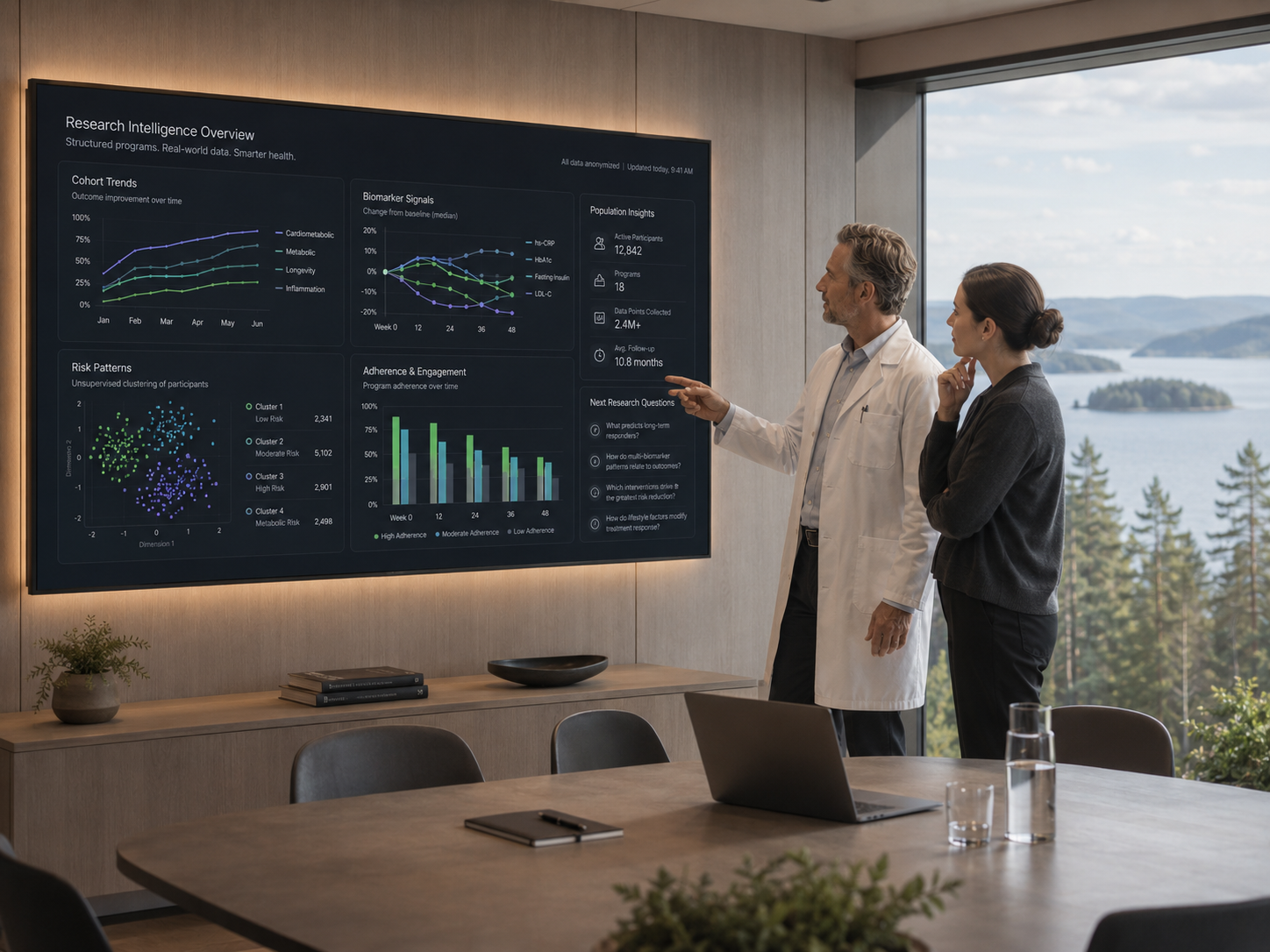
Action in Research Intelligence
In Research Intelligence, action is not only individual.
It is also collective.
Patterns found in real-world data can lead to new research questions, improved models, better products, new diagnostic pathways and more effective programs.
A learning system should not only describe what happened.
It should help decide what should be built next.
Which patterns deserve deeper investigation?
Which programs should be improved?
Which models need validation?
Which products could solve a real health problem?
Which outcomes should be followed more closely?
Research becomes actionable when it changes how health intelligence is developed.
The role of expert judgment
Actionable decisions require judgment.
AI can help identify patterns and summarize data, but it should not carry responsibility alone.
Experts help decide whether a recommendation is appropriate, whether a finding is clinically meaningful, whether a person needs escalation and whether a program is suitable.
This is especially important when the situation is complex, emotionally sensitive or medically relevant.
The Institute model is built to combine AI-supported analysis with human expertise so that actions are better grounded.
Follow-up as part of action
A decision is incomplete without follow-up.
If a person changes a routine, repeats a test, enters a program or receives a recommendation, the next question is:
What happened after that?
Follow-up turns action into learning.
It helps show whether a pattern changed, whether a plan was useful, whether a concern resolved or whether further support is needed.
This is why High Coast Health Intelligence Institute connects decisions to structured follow-up.
Action should not be a one-time event.
It should be part of a continuous process.
Avoiding unnecessary action
Actionable health decisions should not mean doing more than necessary.
Sometimes health intelligence should prevent unnecessary action.
It can help identify when a finding is stable, when monitoring is enough, when reassurance is appropriate or when a person does not need additional testing.
Good decision support should reduce noise.
It should not create anxiety or overmedicalization.
The Institute’s goal is to help people act when action is meaningful — and avoid unnecessary steps when they are not.
The core idea
Actionable health decisions are where the Institute model becomes practical.
Diagnostics and data are not enough.
AI insight is not enough.
Expert interpretation is not enough.
The value appears when knowledge supports a clear, responsible next step.
High Coast Health Intelligence Institute turns health information into decisions that can be understood, acted on and followed over time.
Better knowledge should lead to better decisions.
Better decisions should lead to better lives.