Better outcomes and new knowledge
The learning layer of the model
Better outcomes and new knowledge are the final layer of the High Coast Health Intelligence Institute model.
Human need defines the question.
Diagnostics and data make the question measurable.
The AI intelligence layer helps structure information and identify patterns.
The expert network adds judgment and responsibility.
Actionable health decisions turn insight into practical next steps.
But the model should not stop there.
The final question is:
What happened next?
Did the person improve?
Did the pattern change?
Was the decision useful?
Was follow-up needed?
Did the program create value?
What can be learned for the future?
This is where health intelligence becomes a learning system.
Why outcomes matter
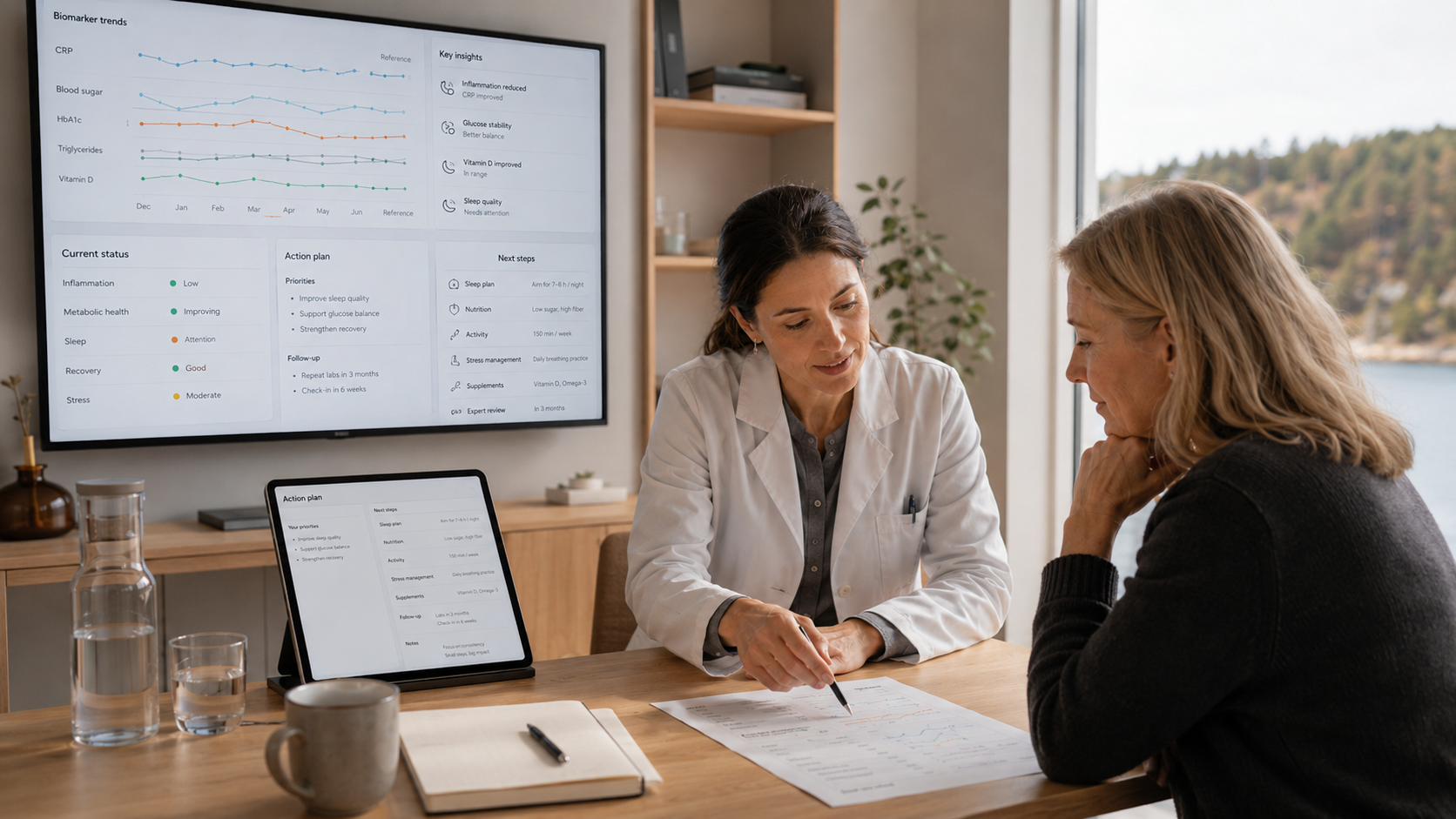
Health decisions should be followed by outcomes.
A recommendation has limited value if no one knows whether it helped.
A diagnostic result becomes more useful when it can be connected to what happened afterward.
A program becomes stronger when it learns from real-world follow-up.
High Coast Health Intelligence Institute is built to connect decisions with outcomes.
The goal is not only to provide information in the moment.
The goal is to improve the quality of decisions over time.
From individual progress to shared learning
Every person enters a health program with an individual need.
They may want better long-term health, closer pregnancy monitoring, clearer diagnostic interpretation, recovery support or a structured preventive plan.
The first responsibility is always to the individual.
But when data is collected responsibly and followed over time, individual journeys can also contribute to broader learning.
Patterns may become visible.
Some signals may prove more useful than expected.
Some interventions may work better for certain groups.
Some risks may need earlier attention.
Some recommendations may need to be improved.
This creates a learning loop where individual support and collective knowledge can strengthen each other.
Better outcomes
Better outcomes can mean different things in different projects.
In Longevity Intelligence, better outcomes may include improved biomarker patterns, better metabolic health, lower inflammation, stronger recovery, improved sleep, better fitness, healthier routines or clearer long-term risk management.
In Pregnancy Intelligence, better outcomes may include better structured monitoring, clearer follow-up, earlier response to trigger events, improved reassurance when trends are stable and better guidance during a sensitive period.
In Diagnostics Intelligence, better outcomes may include more meaningful testing, clearer interpretation, better follow-up plans and fewer isolated results without direction.
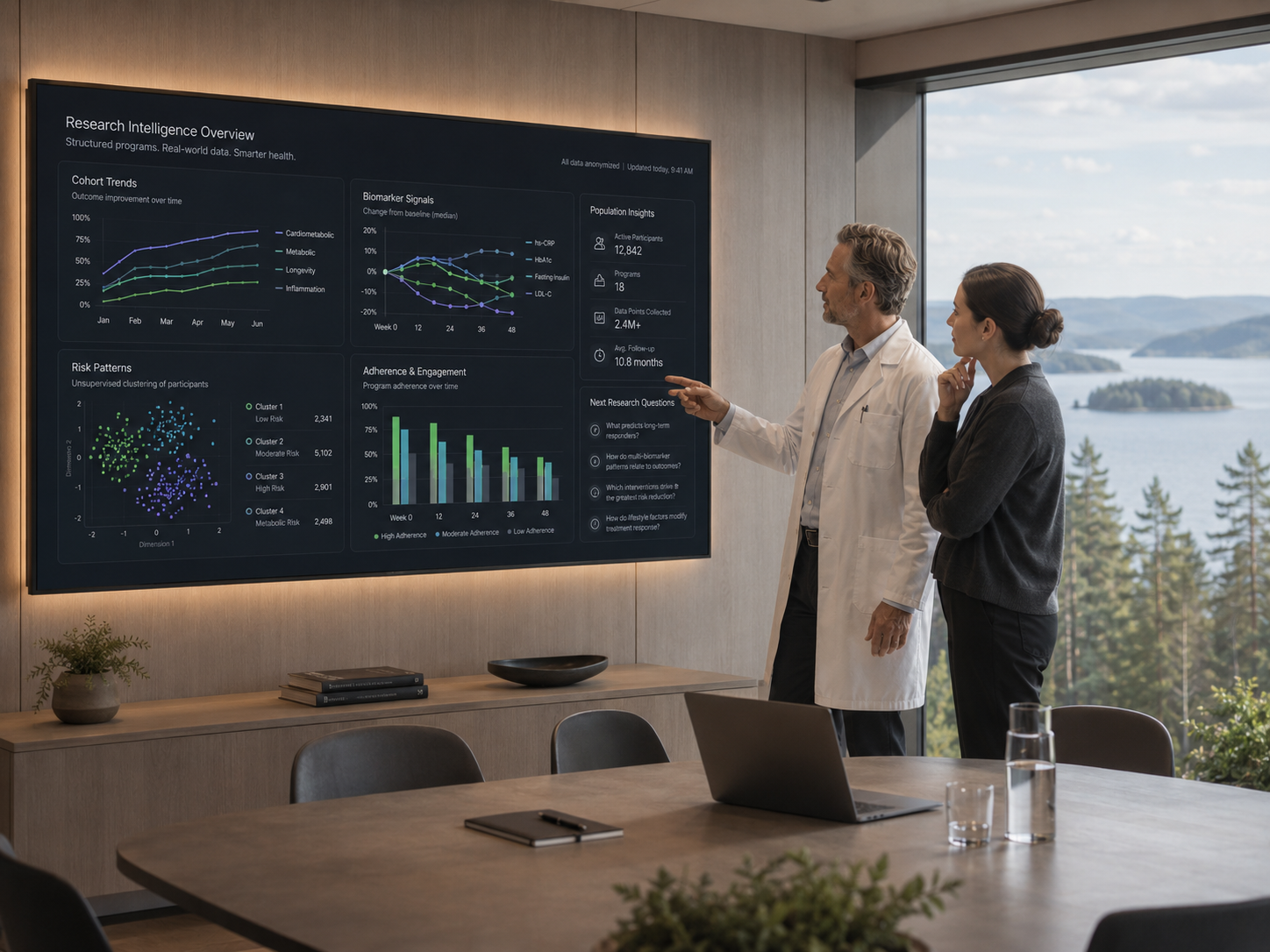
In Research Intelligence, better outcomes may include stronger models, better research questions, improved products and more useful health intelligence systems.
The specific outcomes differ.
The principle is the same:
health decisions should lead somewhere measurable, understandable or useful.
New knowledge
New knowledge is created when structured experience is followed over time.
A single case may teach something.
A structured program can teach much more.
When many participants are followed responsibly, the Institute can begin to ask deeper questions:
Which patterns appear before outcomes change?
Which biomarkers are most useful in context?
Which symptoms should trigger closer follow-up?
Which interventions are associated with improvement?
Which groups respond differently?
Which data combinations create better decision support?
Which products or programs should be developed next?
This is how real-world experience can become research intelligence.
The role of follow-up
Follow-up is essential.
Without follow-up, health intelligence becomes incomplete.
A test result may show a risk, but follow-up shows whether that risk changed.
A recommendation may sound reasonable, but follow-up shows whether it was practical.
A program may be promising, but follow-up shows whether it created value.
Follow-up allows the Institute to move beyond isolated events.
It connects the first question to the later result.
It turns health programs into learning systems.
Outcomes across time
Many meaningful health outcomes do not appear immediately.
Longevity, prevention, metabolic change, inflammation, recovery and cardiovascular risk often require long-term follow-up.
Pregnancy monitoring may require closer follow-up across days and weeks.
Research and product development may require patterns across months or years.
The Institute model is designed to work across these different time horizons.
Some decisions need quick response.
Some require repeated measurement.
Some require long-term tracking.
A health intelligence system must be able to support all three.
Learning responsibly
New knowledge must be created responsibly.
Health data is sensitive.
Real-world learning requires trust, consent, privacy, clear governance and careful interpretation.
The Institute’s ambition is not to collect data without purpose.
It is to build responsible learning systems where data is connected to meaningful questions and useful outcomes.
AI can help detect patterns, but those patterns must be evaluated carefully.
Research must respect ethical boundaries.
Products must solve real needs.
Knowledge should be created in a way that supports people, not exploits them.
From outcomes to better models
When outcomes are followed, models can improve.
AI systems can be refined.
Diagnostic panels can become more relevant.
Expert workflows can become clearer.
Programs can become more effective.
Research questions can become sharper.
Partner products can become better aligned with real-world needs.
This is one of the strongest reasons to build the Institute as a platform rather than a single service.
Each project can learn from its own outcomes.
The whole ecosystem can learn across projects.
A continuous loop
The model is not linear once it begins to operate.
It becomes a loop.
Human need leads to diagnostics and data.
Data leads to AI-supported insight.
Insight is reviewed by experts.
Experts support decisions.
Decisions lead to follow-up.
Follow-up creates outcomes.
Outcomes create new knowledge.
New knowledge improves the next version of the model.
This is the foundation of a learning health intelligence system.
The core idea
Better outcomes and new knowledge are the reason the Institute model exists.
The goal is not only to measure health.
The goal is to improve decisions.
The goal is not only to provide services.
The goal is to build systems that learn.
High Coast Health Intelligence Institute connects human need, diagnostics, AI, expert networks, programs and follow-up so that health intelligence can improve over time.
Better knowledge should lead to better decisions.
Better decisions should lead to better lives.