
Data Layers
Connecting health information into useful intelligence
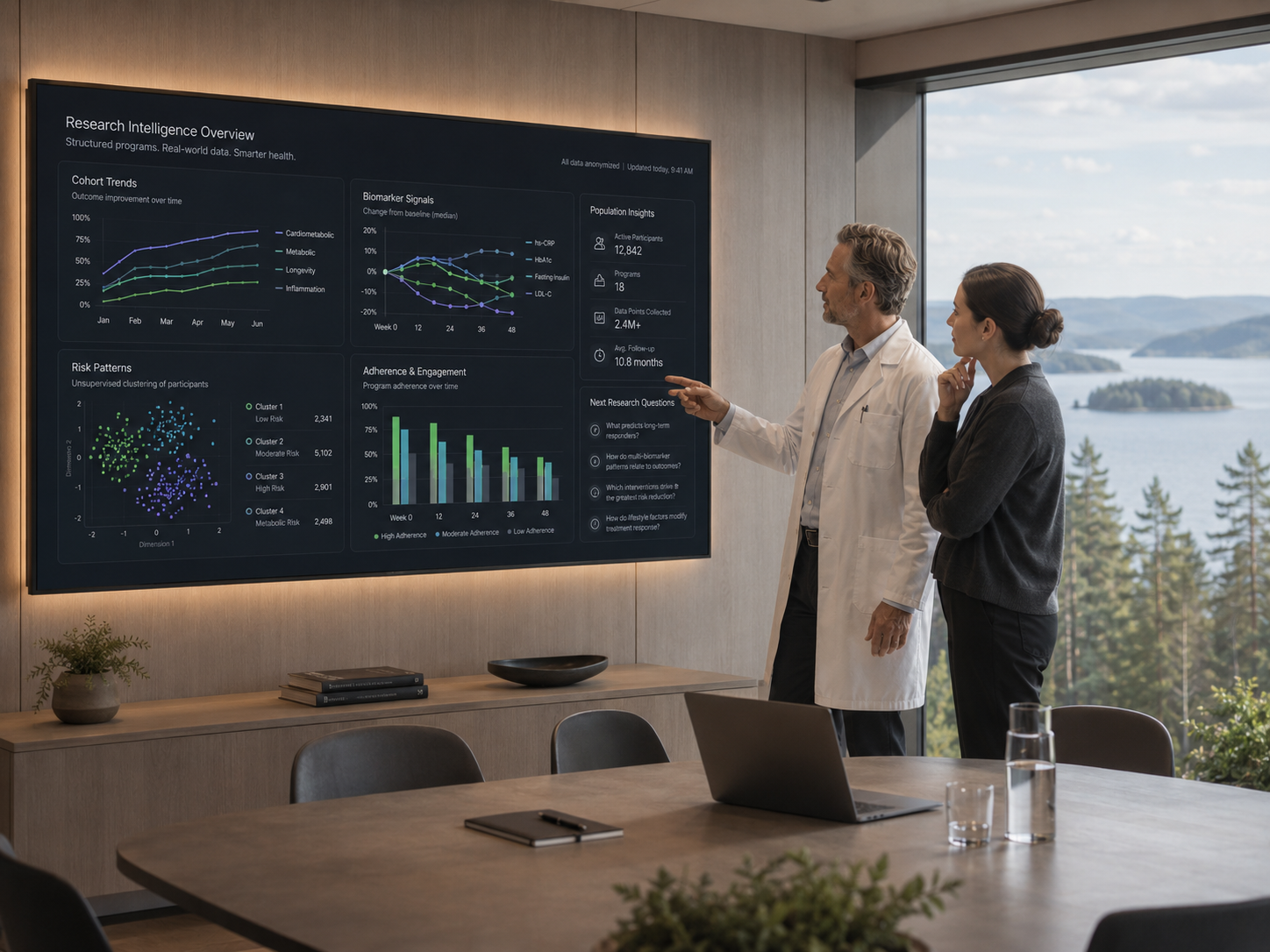
Data Layers describe the different types of health information that High Coast Health Intelligence Institute can connect, structure and interpret.
A lab result can be useful.
But health intelligence rarely comes from one data point alone.
It comes from connecting several layers of information:
longitudinal tracking
symptom data
wearables and lifestyle data
trigger-event data
structured follow-up
population-level learning
Each layer adds context.
Together, they can help transform isolated information into better-supported health decisions.

Why data layers matter
Health is dynamic.
Biomarkers change.
Symptoms change.
Lifestyle changes.
Pregnancy develops over time.
Recovery patterns shift.
Risk factors evolve.
Interventions may or may not work.
A single measurement can show a moment.
But layered data can show a pattern.
That pattern may help answer more useful questions:
What is changing?
What is stable?
What happened before the change?
What happened after an action?
Which signals matter together?
Which patterns need expert review?
Which findings can guide follow-up?
This is why the Institute works with data layers rather than isolated data points.
Longitudinal tracking
Longitudinal tracking means following health signals over time.
This is one of the most important data layers in health intelligence.
A biomarker value taken once can provide a snapshot.
The same biomarker followed repeatedly can show direction.
Is inflammation improving?
Is metabolic health changing?
Are cardiovascular markers stable?
Is a pregnancy biomarker rising as expected?
Is nutritional status improving?
Is recovery getting better?
Longitudinal tracking is especially important in Longevity Intelligence, Pregnancy Intelligence, Diagnostics Intelligence and Research Intelligence.
It allows the Institute to understand not only where someone is today, but how their biological pattern is moving.
Symptom data
Symptoms are an essential data layer.
They represent the person’s lived experience.
Fatigue, nausea, pain, bleeding, sleep problems, mood changes, recovery problems, dizziness, digestive symptoms, anxiety or changes in physical capacity may all provide important context.
Symptoms can be difficult to interpret alone.
But when symptom data is connected to biomarkers, timing, medical history and follow-up, it becomes more meaningful.
In Pregnancy Intelligence, symptom tracking can help structure early pregnancy monitoring and trigger-event response.
In Longevity Intelligence, symptoms can help connect biological patterns to how a person actually feels and functions.
In Diagnostics Intelligence, symptoms can support more relevant interpretation of test results.
The goal is not to overreact to every symptom.
The goal is to create context.
Wearables and lifestyle data
Wearables and lifestyle data can add another layer of insight.
This may include information related to:
sleep
activity
heart rate
heart rate variability
recovery
training load
stress patterns
nutrition habits
weight and body composition
daily routines
Wearable data is not always clinically precise.
But it can still be useful when interpreted carefully and combined with other information.
For example, a biomarker trend may become more understandable when connected to changes in sleep, activity, stress, nutrition or recovery.
The Institute does not treat wearable data as a replacement for diagnostics.
It is a supporting layer that can help explain patterns and guide follow-up.
Trigger-event data
Trigger-event data describes important events that may change the interpretation of health information.
A trigger event may include:
bleeding in early pregnancy
new or worsening symptoms
a major change in sleep or recovery
acute illness
medication changes
new test results
a high-risk biomarker change
a change in training load
a stressful life event
a clinical warning sign
Trigger events are important because they can create a need for action, repeat testing, expert review or healthcare contact.
In Pregnancy Intelligence, bleeding episodes are a clear example of trigger-event data.
In Longevity Intelligence, a sudden change in a biomarker or recovery pattern may also require closer attention.
Trigger-event data helps health intelligence become responsive rather than passive.
Structured follow-up
Structured follow-up is the layer that connects decisions to outcomes.
A recommendation is only truly useful if we can later ask:
What happened after that?
Did symptoms change?
Did biomarkers improve?
Was the plan realistic?
Was further action needed?
Did the person feel better?
Did the risk pattern change?
Did the program create value?
Structured follow-up turns health programs into learning systems.
It helps individuals understand progress.
It helps experts improve decisions.
It helps the Institute develop better models over time.
Without follow-up, health intelligence remains incomplete.
Population-level learning
Population-level learning means learning from structured data across groups of people.
This does not mean treating people as anonymous numbers without context.
It means using responsibly collected, consent-based and privacy-protected data to identify patterns that may improve future health intelligence.
Population-level learning can help answer questions such as:
Which biomarker patterns appear most often?
Which symptom combinations matter?
Which follow-up pathways work best?
Which groups respond differently?
Which interventions are associated with improvement?
Which diagnostic panels are most useful?
Which trigger events need faster response?
This is especially important for Research Intelligence.
It allows structured programs to become learning systems.
Data layers in Pregnancy Intelligence
Pregnancy Intelligence depends on layered data.
Blood tests alone are not enough.
Symptoms alone are not enough.
Timing alone is not enough.
But together, they can create a clearer monitoring pathway.
Pregnancy data layers may include:
hCG and progesterone trends
pregnancy timing
symptom tracking
bleeding episodes
IVF history
previous miscarriage history
follow-up testing
human expert review when needed
The purpose is not to create false certainty.
The purpose is to support better structure, clearer next steps and more responsible guidance during early pregnancy.
Data layers in Longevity Intelligence
Longevity Intelligence also depends on layered data.
Long-term health is shaped by several biological and lifestyle systems.
Longevity data layers may include:
biomarker panels
metabolic and cardiovascular markers
inflammation signals
nutritional status
sleep and recovery data
activity patterns
symptoms and function
biological age indicators
follow-up after interventions
These layers help identify which priorities matter most for a person’s healthspan.
The goal is not generic longevity advice.
The goal is personalized, measurable and actionable health intelligence.
Data layers in Diagnostics Intelligence
Diagnostics Intelligence uses data layers to make testing more meaningful.
A lab result becomes more useful when connected to:
previous results
symptoms
medical history
timing
risk factors
AI-supported interpretation
expert review
follow-up outcomes
This creates a stronger interpretation pathway.
Instead of delivering isolated values, Diagnostics Intelligence helps turn test results into structured insight.
Data layers in Research Intelligence
Research Intelligence uses data layers to identify patterns, develop models and create new health products.
When real-world data is structured responsibly, it can support:
pattern detection
risk stratification
trend analysis
trigger-event detection
decision support models
program improvement
new product opportunities
Data layers are what allow research to move from isolated observations to learning systems.
AI-supported data integration
AI can help connect and organize data layers.
It can support:
trend summaries
pattern recognition
data comparison
risk signal detection
prioritization
decision support preparation
research analysis
follow-up planning
But AI must be used carefully.
Layered data can be sensitive, complex and context-dependent.
AI should support human expertise, not replace it.
The Institute’s approach is to combine AI-supported integration with clinical caution, expert interpretation, privacy protection and responsible governance.
Privacy, consent and trust
Data layers create value, but they also create responsibility.
Health data is sensitive.
Pregnancy data is sensitive.
Longitudinal data is sensitive.
Population-level learning requires trust.
High Coast Health Intelligence Institute’s approach to data must be based on:
clear purpose
consent-based use
privacy protection
appropriate anonymization
data quality
traceability
human oversight
ethical governance
Without trust, data cannot become health intelligence.
From layers to decisions
The purpose of data layers is not to collect more information.
The purpose is to support better decisions.
Layered data can help clarify:
what matters now
what should be followed
what is improving
what is worsening
what may need expert review
what action may be reasonable
what can be learned over time
This is how health data becomes useful.
It becomes connected.
It becomes contextual.
It becomes actionable.
The core idea
Data Layers are the foundation for meaningful health intelligence.
Longitudinal tracking shows change.
Symptom data shows lived experience.
Wearables and lifestyle data add context.
Trigger-event data supports timely response.
Structured follow-up connects decisions to outcomes.
Population-level learning improves future models.
Together, these layers help High Coast Health Intelligence Institute turn health information into better decisions and new knowledge.