
Interpretation & Guidance
Turning results into better decisions
Interpretation & Guidance is a central part of the Diagnostics & Data platform at High Coast Health Intelligence Institute.
Diagnostics become useful only when people understand what the results mean and what should happen next.
A lab value can be accurate but still unclear.
A biomarker panel can be detailed but still difficult to act on.
A trend can be visible but not yet translated into a decision.
Interpretation & Guidance exists to close this gap.
The goal is to turn diagnostic results, biomarker patterns, symptoms, history and follow-up data into clearer priorities and practical next steps.

Why interpretation matters
More health data does not automatically create better health.
In many cases, more data creates more questions.
Is this result important?
Is this value normal for me?
Is the pattern stable or changing?
Should I repeat the test?
Should I change something?
Should I contact healthcare?
Does this need expert review?
What should I focus on first?
High Coast Health Intelligence Institute approaches interpretation as part of a structured health intelligence pathway.
The result should not stand alone.
It should be connected to context, risk, action and follow-up.
Understanding results
Understanding results begins with making diagnostic information clearer.
A result should be explained in relation to:
the person’s question
previous values
reference ranges
symptoms
medical history
timing
risk factors
project context
follow-up needs
A value may be inside a reference range but still relevant if it is changing over time.
A value may be outside a range but less urgent if the context explains it.
A trend may matter more than a single number.
This is why interpretation must be contextual.
The goal is to help people understand what the result may mean — and what it does not mean.
Identifying priorities
Not every result deserves the same attention.
One of the most important tasks in Interpretation & Guidance is prioritization.
A diagnostic report may contain many values, but a person usually needs to know:
What matters most?
What is reassuring?
What should be followed?
What can be improved?
What may need expert review?
What should be addressed first?
Prioritization helps reduce confusion.
It also helps avoid unnecessary worry.
The purpose is not to make every value feel urgent.
The purpose is to identify what is most relevant for the person’s health question and next step.
Risk patterns
Health risk is rarely explained by one marker alone.
Risk patterns often appear across several layers of data:
biomarkers
symptoms
medical history
lifestyle context
wearable signals
timing
previous results
follow-up outcomes
For example, metabolic risk may be clearer when glucose regulation, lipid markers, inflammation, body composition and lifestyle context are interpreted together.
Pregnancy monitoring may become clearer when hCG trends, progesterone values, symptoms, bleeding episodes and timing are connected.
Longevity assessment may become more useful when inflammation, cardiovascular markers, nutritional status, recovery and biological age indicators are interpreted as a system.
Interpretation & Guidance helps identify these patterns.
Personalized recommendations
Guidance should be personalized enough to be useful, but careful enough to remain responsible.
A recommendation may involve:
repeat testing
structured follow-up
lifestyle priorities
nutrition or recovery direction
program participation
expert consultation
clinical review
healthcare contact
reassurance and monitoring
The right recommendation depends on context.
The Institute’s goal is not to deliver generic advice.
The goal is to help translate health intelligence into a reasonable next step.
A useful recommendation should be understandable, practical and connected to follow-up.
Human expertise when needed
AI-supported interpretation can help organize results, identify patterns and prepare summaries.
But AI should not be the final authority in sensitive, uncertain or medically important situations.
Human expertise remains essential.
Expert review may be needed when:
results are unclear
patterns are concerning
symptoms are significant
pregnancy-related signals need careful interpretation
advanced diagnostics require context
medical boundaries are involved
a recommendation could affect clinical decisions
there is a need for reassurance or explanation
High Coast Health Intelligence Institute is built around the combination of AI-supported structure and human judgment.
That balance is central to trust.
Interpretation in Longevity Intelligence
In Longevity Intelligence, interpretation helps people understand long-term biological risk factors and healthspan priorities.
A person may have data related to inflammation, metabolic health, cardiovascular markers, hormonal balance, nutritional status, recovery, body composition or biological age.
The key question is:
Which areas matter most for this person’s long-term health?
Interpretation & Guidance helps turn longevity data into priorities, action plans and follow-up strategies.
The goal is not to reduce longevity to a score.
The goal is to understand what can be improved and what should be followed over time.
Interpretation in Pregnancy Intelligence
In Pregnancy Intelligence, interpretation must be especially careful.
Early pregnancy is emotionally sensitive and biologically dynamic.
Blood tests such as hCG and progesterone may provide useful information, but they must be interpreted with timing, symptoms, previous results, IVF history, miscarriage history and trigger events.
The purpose is not to promise certainty.
The purpose is to create more structure and clarity.
Interpretation & Guidance can help identify when trends appear reassuring, when repeat testing may be useful, when a bleeding episode should trigger action and when human expertise or healthcare contact may be needed.
Interpretation in Diagnostics Intelligence
Diagnostics Intelligence depends on interpretation.
A biomarker panel without interpretation is only a list of values.
With structured interpretation, the panel becomes a tool for understanding.
Interpretation & Guidance helps connect:
test results
previous values
symptoms
history
risk context
AI-supported pattern recognition
expert review
follow-up
This makes diagnostics more useful and actionable.
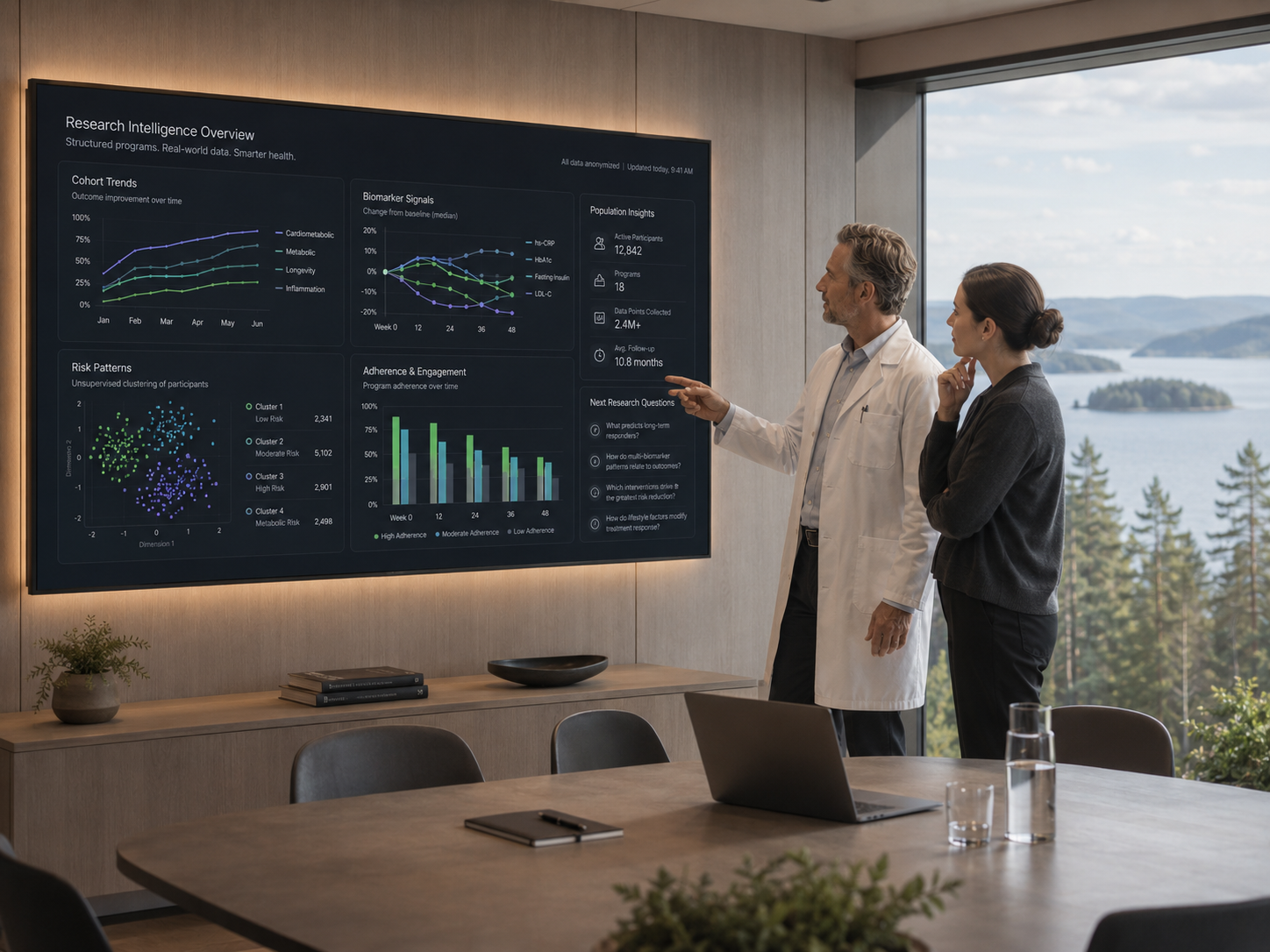
Interpretation in Research Intelligence
When many people move through structured programs, patterns can emerge across groups.
Interpretation helps determine which patterns are meaningful, which are noise and which should become future models or product opportunities.
This may support:
better biomarker panels
improved monitoring pathways
decision support models
new health products
research questions
program improvements
Interpretation is therefore important both for the individual and for the learning system.
Avoiding overinterpretation
Good interpretation also means knowing when not to overinterpret.
Not every small variation is meaningful.
Not every trend requires action.
Not every marker should create concern.
Health intelligence should reduce confusion, not increase anxiety.
The Institute’s approach must avoid false precision, exaggerated claims and unnecessary alarm.
A careful interpretation may sometimes say:
this appears stable
this should be followed
this is unclear
this needs more context
this may need expert review
this is not enough information to draw a conclusion
Responsible guidance is sometimes about restraint.
From guidance to follow-up
Guidance becomes stronger when it is followed over time.
If a recommendation is made, the next question is:
What happened after that?
Did the marker improve?
Did symptoms change?
Was the action realistic?
Was more support needed?
Did the risk pattern change?
Should the plan be adjusted?
Follow-up turns guidance into a learning loop.
This is essential for the Institute’s model.
Interpretation should not be a one-time event.
It should support a pathway over time.
The role of AI-supported interpretation
AI can help make interpretation more structured.
It can support:
result summaries
trend recognition
risk pattern detection
prioritization
comparison across data layers
follow-up suggestions
research learning
But AI must be used within boundaries.
It should help prepare information, not replace responsibility.
High Coast Health Intelligence Institute uses AI-supported interpretation as part of a broader model that includes expert review, clinical caution, ethical data use and human-centered guidance.
The core idea
Interpretation & Guidance turns diagnostics and data into understandable priorities and practical next steps.
It helps people understand results, identify priorities, recognize risk patterns, receive personalized recommendations and access human expertise when needed.
The goal is not more information.
The goal is better understanding.
Better understanding should support better decisions.
Better decisions should lead to better health.