Longevity Formats
Structured formats for long-term health and healthspan
Longevity Formats describe the different ways Longevity Intelligence can be delivered through High Coast Health Intelligence Institute.
Longevity is not one single service.
Different people need different levels of assessment, support, follow-up and experience.
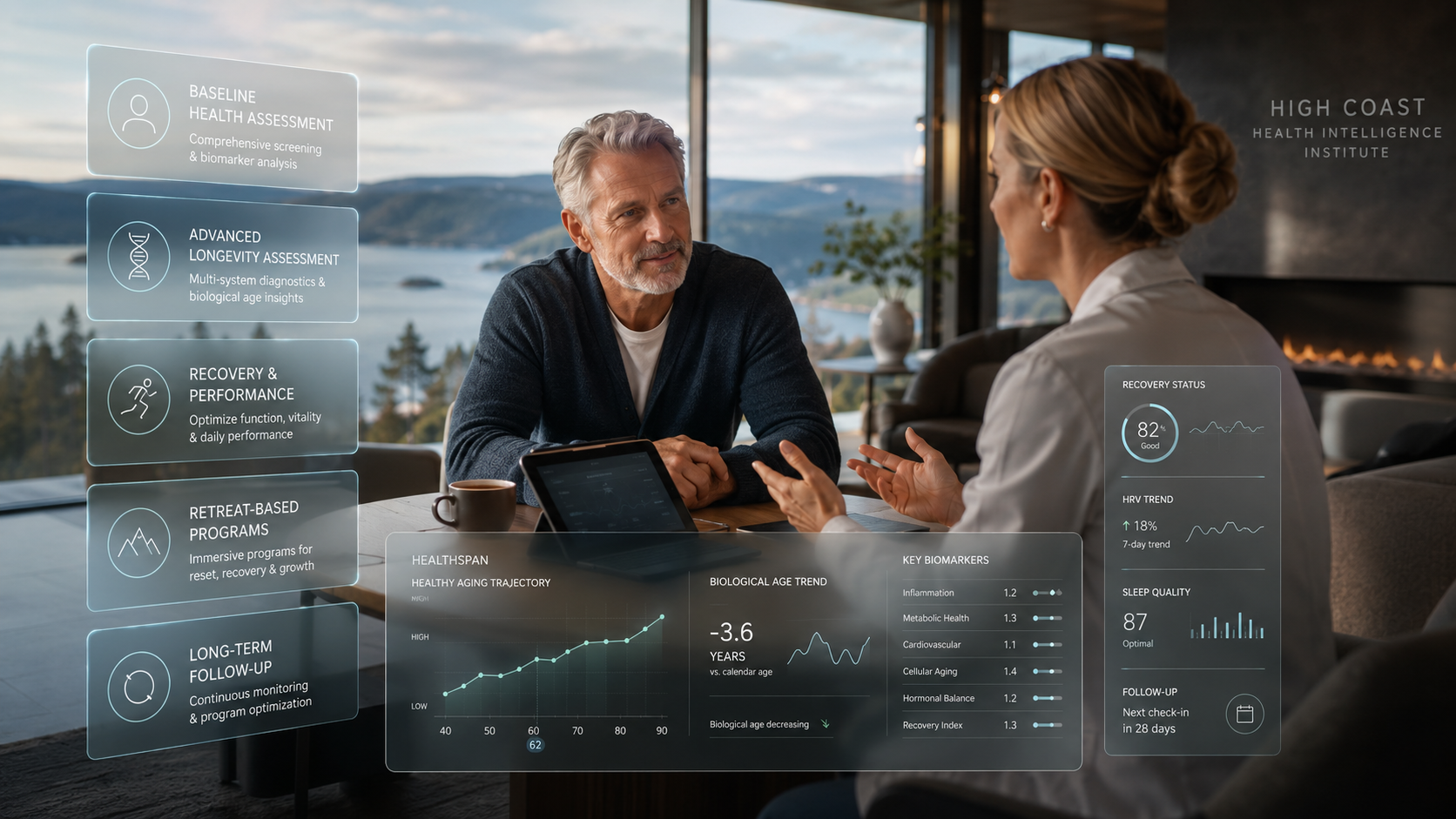
Some may need a baseline understanding of their health.
Some may need a deeper biological assessment.
Some may focus on recovery, performance or resilience.
Some may benefit from a structured retreat-based program in the High Coast.
Some may need long-term follow-up over months or years.
The purpose of Longevity Formats is to make healthspan work practical, measurable and adaptable.
Why longevity needs formats
Longevity often becomes too abstract.
People hear about biological age, supplements, advanced testing, exercise, nutrition, recovery, sleep and prevention — but it can be difficult to know where to begin.
A structured format creates a starting point.
It helps define:
what should be measured
what the main priorities are
what can be improved
what requires expert interpretation
what actions are realistic
what should be followed over time
Longevity Formats help move from general interest to structured health intelligence.
The goal is not to create more information.
The goal is to create a pathway.
Baseline health assessment
A baseline health assessment is the starting format for many people.
It creates an initial picture of biological health, risk factors and priorities.
A baseline assessment may include:
health history
current symptoms and goals
basic biomarker panels
metabolic health markers
cardiovascular markers
inflammation indicators
organ function
nutritional status
sleep and recovery context
lifestyle overview
AI-supported interpretation
expert guidance when needed
The purpose is to understand the current state.
What looks stable?
What needs attention?
What should be followed?
What can be improved first?
A baseline assessment should be clear, practical and not unnecessarily complicated.
Advanced longevity assessment
An advanced longevity assessment is designed for deeper understanding.
It may be relevant for people who want a more complete biological picture, have complex risk factors, are already working actively with prevention or want a more detailed long-term strategy.
An advanced assessment may include:
expanded biomarker panels
body composition analysis
biological age indicators
advanced cardiovascular markers
metabolic risk profiling
hormonal assessment
inflammation and immune health markers
nutritional and recovery markers
wearable and lifestyle data
AI-supported data integration
expert interpretation
personalized follow-up plan
The goal is not advanced testing for its own sake.
The goal is deeper assessment when it can support better decisions.
Advanced diagnostics should reduce uncertainty, not create unnecessary noise.
Recovery and performance
Recovery and performance are important parts of longevity.
Long-term health is not only about disease risk.
It is also about energy, function, resilience, sleep, physical capacity, cognitive performance and the ability to recover from stress.
A Recovery and Performance format may focus on:
sleep quality
stress load
heart rate variability
training response
fatigue patterns
nutritional status
inflammation
hormonal context
physical capacity
recovery routines
performance goals
follow-up over time
This format may be useful for active individuals, professionals under high stress, people recovering from fatigue or people who want to improve function before problems become larger.
The aim is to understand how the body adapts, recovers and performs.
Retreat-based programs
Retreat-based programs are one of the most distinctive Longevity Formats.
A retreat can create time and space for assessment, reflection, education, recovery and structured planning.
In the High Coast setting, a retreat-based program may combine:
diagnostics
health assessment
expert consultations
education sessions
movement and recovery routines
sleep and stress support
nutrition and lifestyle review
nature-based activities
personalized planning
follow-up after the stay
The High Coast environment can support reflection, recovery and long-term thinking.
But the environment is not the program by itself.
A serious longevity retreat should be built on diagnostics, interpretation, expert guidance and follow-up.
The goal is not a wellness escape.
The goal is a structured health intelligence experience.
Long-term follow-up
Long-term follow-up is essential for meaningful longevity work.
A single assessment can provide insight, but change happens over time.
Follow-up helps answer:
Did the biomarkers improve?
Did symptoms change?
Did sleep and recovery improve?
Did the plan work in real life?
What should be adjusted?
Which risk factors remain?
Which new priorities have appeared?
Long-term follow-up may include:
repeat testing
digital monitoring
symptom and lifestyle tracking
expert review
program adjustment
progress reports
trend analysis
research learning
This format is where longevity becomes a continuous process rather than a one-time assessment.
Digital longevity monitoring
Digital monitoring can support several Longevity Formats.
It allows participants to follow progress between assessments, consultations or retreats.
Digital monitoring may include:
biomarker trends
wearable data
sleep and recovery tracking
symptom logs
lifestyle check-ins
AI-supported summaries
follow-up reminders
personalized recommendations
expert review when needed
Digital monitoring is not a replacement for human expertise.
It is a continuity layer.
It helps keep the program active over time.
Clinic-based longevity programs
Some longevity formats may be clinic-based.
A clinic-based format can support blood testing, physical assessment, medical history review, expert consultation and follow-up planning.
This may be especially relevant when the person has risk factors, complex results or a need for closer professional interpretation.
Clinic-based longevity programs can help connect diagnostics with responsibility.
They can also serve as a bridge between preventive health, clinical review and structured long-term programs.
Hybrid longevity formats
Many longevity programs will likely be hybrid.
A person may begin with digital intake, complete testing through a clinic or laboratory partner, receive AI-supported interpretation, discuss results with an expert, attend a retreat or short stay, and then continue with digital follow-up.
Hybrid formats can combine:
digital access
laboratory testing
expert interpretation
physical experience
structured routines
long-term monitoring
partner delivery
This may become one of the most scalable ways to deliver Longevity Intelligence.
The format can be flexible, while the structure remains clear.
From assessment to action
Longevity Formats should always move toward action.
An assessment without next steps is incomplete.
A retreat without follow-up is temporary.
A digital dashboard without interpretation is only data.
The program should help identify:
what matters most
what should be improved
what can be acted on now
what should be followed
what needs expert review
what should be reassessed later
The action plan should be realistic, measurable and connected to the person’s actual life.
This is how longevity becomes practical.
Human expertise and AI support
Longevity data can become complex.
AI can help structure information, identify patterns, summarize trends and support interpretation.
But longevity decisions require judgment.
Human expertise is needed to understand context, avoid overinterpretation, identify limitations and translate findings into realistic guidance.
Longevity Formats should therefore combine:
AI-supported data organization
expert interpretation
personalized guidance
responsible follow-up
Technology should support the human pathway.
It should not replace it.
Longevity formats as learning systems
Each Longevity Format can also support research and learning.
When assessments, recommendations and follow-up are structured responsibly, the Institute can learn over time.
This may help identify:
which markers are most useful
which programs create measurable improvement
which patterns predict better outcomes
which interventions are realistic
which future products should be developed
which formats create the most value
Longevity Formats therefore support both the individual and the broader Research Intelligence platform.
Choosing the right longevity format
The right format depends on the person’s needs.
A person new to prevention may start with a baseline assessment.
A person with deeper interest or complex goals may choose an advanced assessment.
A person focused on fatigue, stress or function may enter through recovery and performance.
A person seeking a more immersive experience may choose a retreat-based format.
A person committed to continuous improvement may use long-term follow-up.
The format should fit the question.
Not the other way around.
The core idea
Longevity Formats make Longevity Intelligence usable.
Baseline health assessment.
Advanced longevity assessment.
Recovery and performance.
Retreat-based programs.
Long-term follow-up.
Digital, clinic-based and hybrid pathways.
Each format helps turn longevity from a broad idea into a structured health intelligence process.
The goal is not simply to live longer.
The goal is to understand biology earlier, act more intelligently and preserve health, function and resilience over time.